Copy article

HSBC, Accord Increasing Fixed Rates as Swaps worsen

Journalist: Justin Moy, Contributing Editor

ended 22. April 2024

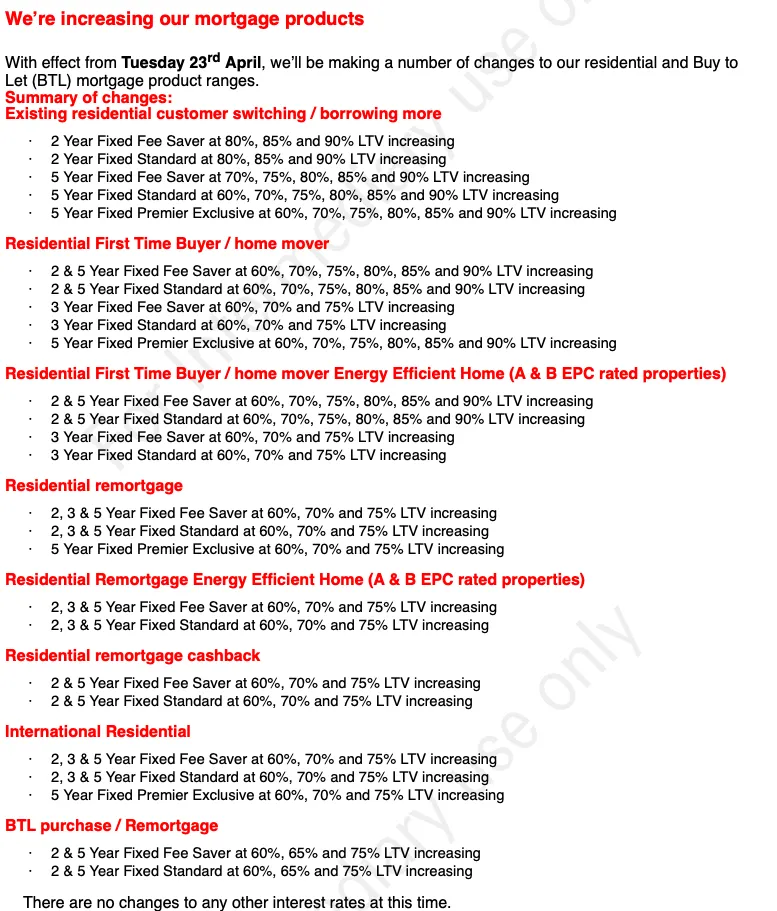
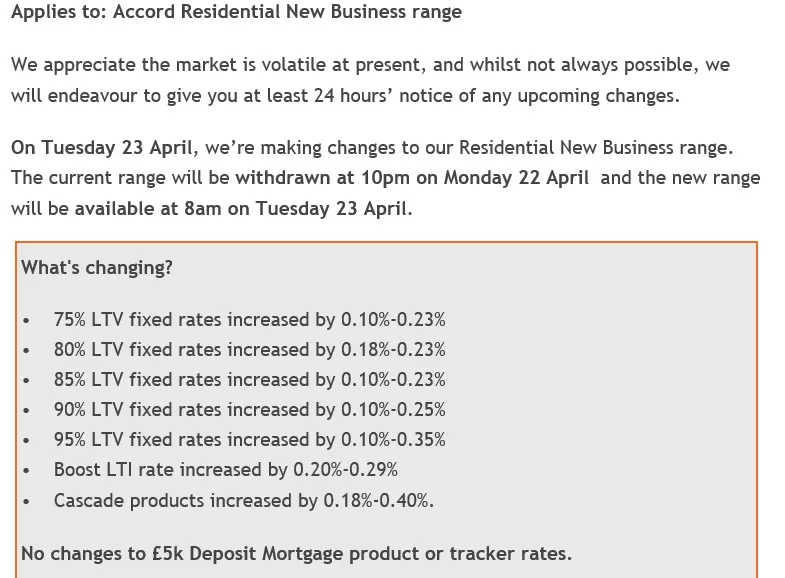
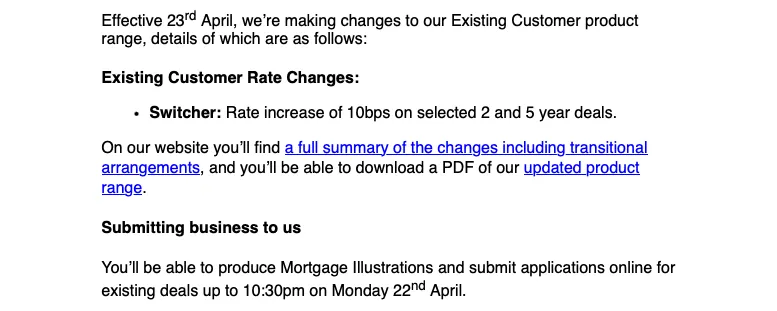
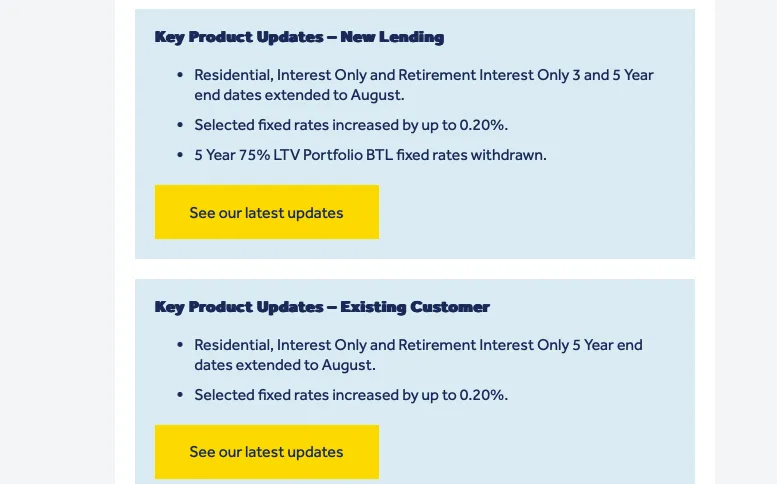
NatWest,  Accord, Leeds BS and HSBC have announced rate increases this morning, in response to increases in Swap rates over the last few days. With a cut to base rate looking less likely in the coming months, the money markets are pricing in for higher rates in the short term.

We asked for comments from the Newspage Mortgage Brokers, in particular, what this means for borrowers in the short and long term, the effect on those looking to buy, and will we see more increases over the next few months.
18 responses from the Newspage community

Copy all

Star Quote
Copy

This news is compounding the pain of many beleaguered borrowers who simply don’t know which way to turn. This morning, I have been calling clients who have been sitting on the fence urging them to proceed as this increase is potentially going to be with us for several months. Inaction will weigh heavily on household purses so don’t delay, there is a finite amount of hours left to get deals done before the increases take effect , pick up the phone to your broker immediately or you will be paying more money for years to come.
Star Quote
Copy

The lack of a predicted base rate cut creates uncertainty in the long-term borrowing landscape. It's difficult to say definitively if rates will continue to rise or stabilize. This might make borrowers cautious about taking on large debts like mortgages.The long-term picture is less clear. If the base rate increases do happen, it might eventually lead to a more stable economy, potentially benefiting borrowers in the long run. However, there's also a risk of a slowdown in economic growth, which could limit borrowing opportunities.The next few months will be crucial in seeing how the base rate situation unfolds and its eventual impact on borrowing costs.
Star Quote
Copy

The rate rollercoaster rolls on. Just when the market appears to be picking up some momentum, there is a sharp change of direction. We are now seeing the spike in SWAP rates last week, filtering through to the public as lenders raise their rates in response. The volatility we are experiencing currently really amplifies how important it is to secure a rate as soon as possible, as this could saving you hundreds of pounds, especially for exisiting homeowners.
Copy

What is clear, is that the mortgage market is in the spin dryer at the minute. Can only think global events inclusive of the ongoing war in Ukraine, and also the escalation of the events in the middle east has spooked the market.
Copy

4 leading mortgage lenders increasing rates is a disappointing start to the week, and will only create logjams for both brokers and lenders dealing with panicking borrowers. With the Bank of England dithering over the next move, to align with Europe, the USA, or go it alone with its rate-cutting strategy, borrowers will feel the brunt of higher rates and homeowners face an uncertain summer of discontent.
Copy

Unfortunately, the recent rate hikes by NatWest, Accord, Leeds BS, and HSBC were somewhat anticipated given the mixed signals from the economy and increasing uncertainty in the housing market and broader UK economic landscape. These factors, compounded by geopolitical events, have driven swap rates up. For borrowers, this isn't good news, especially amidst the ongoing cost of living crisis. Those looking to buy might find themselves facing higher costs in both the short and long term. We could see more rate increases in the next few months if these conditions persist, putting additional pressure on potential and current homeowners.
Copy

This isn’t news anyone wants to receive on a Monday morning.. However, it confirms how the markets react to volatility and uncertainty around the world, especially the Middle East.
Copy

Swap rates have been edging upward for the last few weeks on the back of disappointing numbers from across the pond and here at home coupled with mounting tensions in the Middle East and ongoing conflict in Ukraine. Analysts are now pricing in fewer reductions than they had expected just 6 weeks ago and lenders are reacting to these increasing swaps. Whats clear is that anyone with a mortgage is not out of the cost of living crisis yet.
Copy

The emails from lenders this morning are as dull and gloomy as the weather outside. Multiple lenders have increased products and this is a trend that looks to continue this week as swap rates continue to creap northward.
The everchanging nature of interest rates at the moment is a real cause for concern. Borrowers are having to rush decisions and act quickly to secure rates before they take a turn, this could leave them vulnerable. We really need stability and only the Bank of England have the power to create this.
Copy

After a pretty calm period rates are starting to creep up again. This is not great timing because there has been more of an expectation that rates would nudge down rather than increase. The cheapest two-year fixes start from 4.6% while lenders like NatWest, Santander and Nationwide offer sub-4.25% five-year fixes. The property market is still busy and lots of people still want mortgages, although some borrowers are waiting for rates to come down. The issue is waiting for rates to come down to 3.5% or lower could take years.
Copy

Recent escalations in SWAP rates, which have shown a stubborn reluctance to decrease, have compelled lenders to make adjustments. It appears we are on the cusp of witnessing a series of rate hikes as lenders who previously held steady are now compelled to respond to the increasing pressures. While this turn of events may seem disheartening for borrowers, there remains a strong conviction that forthcoming inflation reports could serve as a counterbalance, potentially reversing the current trend of rate increases. Nonetheless, as experience teaches us, attempting to time the market can be risky. For many borrowers and potential homebuyers, making decisions sooner rather than later could prove to be most advantageous.
Copy

A summer of mortgage discontent is manifesting as major lenders push rates up further. Home buyers are already frustrated with the market conditions and this will continue to stifle activity. With many unhappy with the costs of mortgages, they will express their displeasure with inaction.
Copy

A swirling hurricane of rate rises is shaking the mortgage market this morning, in a disasterous start to the new week. With SWAP rates having increased in recent days from the lack of expectation of any base rate reduction anytime soon, the Higher for Longer rhetoric is biting hard and lenders are rising their rates, in the case of Barclays twice in a week being swept up in the upwinds. This will spell more dismay for homeowners and potential buyers across the UK.
Copy

We'd be fooled to think that we are near Halloween with the way the markets are spooked. The rollercoaster just continues to roll.
Copy

Negativity is the order of the day (and month/quarter/year). The previous hopes that three base rate cuts could be due this year have been seriously dampened by a series of unfavourable snippets of financial data, and the markets have responded accordingly. More and more people rolling off their lower fixed rates will feel the impact of a rise in mortgage rates and payments.
Copy

Here we go again. The markets have been rattled by the on-going situation in The Middle East. Just when we thought we were heading into calmer waters we seem to be heading into another storm. Hopefully this one is short lived.
Copy

Mortgage rates are like going on a rollercoaster, they are going up and down on a regular basis and we dont know is when the volatility will stop.
Copy

Mortgage Market in Turmoil is the word on the streets with lenders across the board hike rates amidst growing economic uncertainty.

As financial instability continues, a growing number of lenders are rapidly increasing their mortgage rates, leaving potential homebuyers and existing homeowners grappling with unexpected costs. This widespread trend signals deepening concerns over the volatile economic climate, affecting affordability and access to housing across the UK.