Copy article

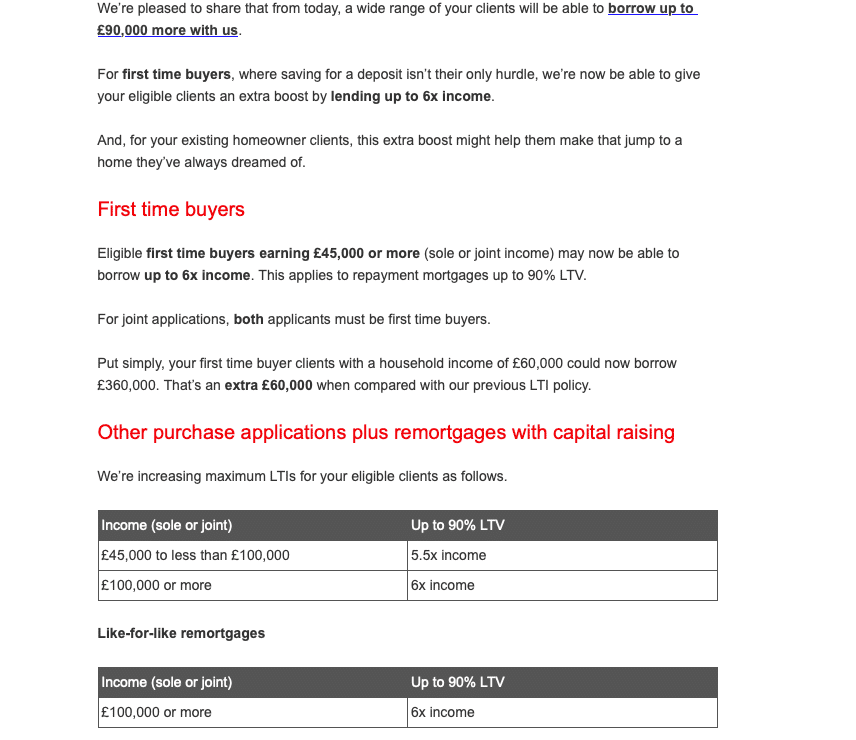
Santander offering 6 times salary mortgages

ended 17. November 2026

From Santander:

Questions for Newspagers

  1. Is this a positive move for mortgage borrowers?
  2. What are the negatives in this move for mortgage borrowers?
  3. Do others offer 6x salary? Will more move to this?

10 responses from the Newspage community

Copy all

Star Quote
Copy

Pro
Aaron StruttVerified
Product and Communications Director at Trinity Financial
iContact details are shown to logged-in members. Log in
Santander has increased its maximum mortgage income multiple to six times salary for first-time buyers and higher earners which will come as a welcome boost to many of its customers. The lender was pretty generous before this change offering up to 5.5 times salary but not as generous as its competitors which has no doubt meant it has lost business to rival banks offering bigger income multiples.
Santander regularly tops the mortgage best buy tables with cheap rates and has some decent acceptance criteria, especially for those keen to take interest-only or lower deposit mortgages; the lender also tends to have competitively priced longer-term fixes
There is a surprising number of lenders offering six times salary mortgages already, so Santander is a bit late to bring its policy in line with its competitors but better late than never. Nationwide, Barclays, NatWest and HSBC are some of the lenders offering six times salary with varying qualification and income requirements.
Copy

Pro
Justin MoyVerified
Managing Director at EHF Mortgages
iContact details are shown to logged-in members. Log in
This brings Santander up to similar levels with other high street lenders. As always, these limits are highlights and for very specific situations, especially where borrowers have high incomes and high disposable income too. There is a limit to how much any human can spend on food, clothes, fuel, etc, each month, so those fortunate to be at the higher end of the pay scales can afford to borrow a little more compared to those on more typical incomes. Overall affordabilty still rules and will continue to define what any client can afford to borrow.
Copy

Pro
Michelle LawsonVerified
Director at Lawson Financial
iContact details are shown to logged-in members. Log in
Santander are aligning themselves with some other lenders already offering this multiple. This will help with affordability and can be see as a positive move but caution should be taken to not over-borrow and stretch too far. So many borrowers will go for the absolute maximum they can get rather than leaving a headroom. When the market was increasing you could rely on building equity through property values but in a stagnant market, this will only happen usually with organic repayments.
Copy

Pro
Joseph LaneVerified
CEO at Mortgage Lane
iContact details are shown to logged-in members. Log in
For eligible buyers who can comfortably afford the repayments, particularly with strong earnings but a relatively modest deposit, it could make a meaningful difference. On £100,000, going from 5.5 to six times could take borrowing from £550,000 to £600,000. That £50,000 could bridge the gap between moving and staying put. Six times is a maximum, not a guaranteed offer, and affordability checks still apply.

One risk is prices. Where supply is tight, extra borrowing power can feed into asking prices, and more debt alone won’t solve the housing shortage. A bigger limit doesn’t make it cheaper either. It means higher repayments, more interest and less room for childcare, lower earnings or a higher rate when the fix ends. Nationwide and NatWest already offer up to six times, but each lender has its own criteria, so I wouldn’t compare on the headline multiple alone. I’d expect competition to push more to follow selectively, but it’s unlikely to be available to everyone.
Copy

Pro
Rohit KohliVerified
Senior Mortgage Adviser - Residential & Commercial at The Mortgage Stop
iContact details are shown to logged-in members. Log in
It’s a good move by Santander and a positive one for first-time buyers. It’s really challenging out there for people trying to get on the ladder, and if they’re going to get into property, they’re going to need more help. Stretching how much they can borrow does exactly that.

But six times your income is a stretch. The more you borrow, the more you pay each month, so part of our job as advisers is making sure that level of borrowing is genuinely right for you, not just possible. Having somewhere to live is one thing. Being able to afford to live is another.

The other catch is the deposit. This is capped at 90% loan-to-value, so buyers need 10% saved, and that’s a big hurdle for many. More and more of the people we speak to have 5% or less. It’s just a shame it stops at 90%.

Santander isn’t the only lender going to this level, and I think more will follow. Affordability isn’t getting any easier, and lenders are going to come under growing pressure to offer higher income multiples.
Copy

Pro
Stephen PerkinsVerified
Mortgage Broker and Managing Director at Yellow Brick Mortgages
iContact details are shown to logged-in members. Log in
This is a positive move because affordability remains one of the biggest barriers facing buyers, particularly first-time buyers. Santander is not simply offering six times income to everybody, but for eligible borrowers the increase could make the difference between being able to buy a suitable home and being priced out.

The important point is that six times income is a maximum, not a target. Borrowers live with the monthly payment, not an income multiple, so taking the largest mortgage available will not always be the right decision.

Other lenders already offer enhanced income multiples, so Santander moving further in this direction should increase competition. I would expect more lenders to keep reviewing how far their affordability criteria can safely stretch.
Copy

Pro
Tony RedondoVerified
Founder at Cosmos Currency Exchange
iContact details are shown to logged-in members. Log in
Santander joining Nationwide, NatWest and Barclays in offering 6x salary mortgages is a commercial play for market share, and a double-edged sword for borrowers. The upside: it bridges the widening gap between wages and house prices, helping creditworthy, higher-earning buyers onto the ladder without leaning on the Bank of Mum and Dad. The downside: borrowing at six times income leaves households’ razor-thin buffers against rate shocks or a downturn. And pumping extra credit into a supply-starved market doesn’t build a single extra home, it just bids up asking prices. More lenders will follow, within Bank of England limits. But there’s a real danger we look back on this wave of hyper-leveraged lending as the moment the post-2008 guardrails quietly slipped, inflating the next credit-driven bubble rather than fixing affordability.
Copy

Pro
Tracey DixonVerified
Buy-to-Let Mortgage Specialist & Owner at Pure Mortgage and Protection
iContact details are shown to logged-in members. Log in
Six times income could open the door to homeownership, but the maximum borrowing figure should never become the target.
This is welcome flexibility for borrowers whose income can comfortably support the repayments but who fall short under traditional income multiples. However, a bigger mortgage leaves less breathing room if earnings fall, bills rise or circumstances change. Eligibility and affordability checks still apply.
Nationwide and Skipton already offer up to six times income for eligible borrowers. I expect competition will encourage more lenders to explore higher multiples, although access will remain subject to individual criteria.

The real test is whether you can afford the mortgage and still afford to live.
Copy

Plus
Matthew Fleming-DuffyVerified
Founder at Harbour Home Finance Ltd
iContact details are shown to logged-in members. Log in
I'm very supportive of lenders adapting their lending criteria to reflect changes in the mortgage market. House prices have outpaced earnings for years, so giving borrowers greater flexibility is welcome, so long as longer-term affordability remains at the heart of the decision. Santander certainly isn't alone; Nationwide, Barclays and NatWest already offer up to six times income for certain borrowers, with some specialist lenders going even further. I think we'll see more lenders following suit. My concern is that we're in something of a Catch-22 situation. We want to help people borrow enough to get onto the property ladder, but persistent inflation could force the Bank of England to raise interest rates further, making those larger mortgages more expensive. Greater choice and flexibility are good things, but borrowing more today mustn't come at the expense of financial security tomorrow.
Copy

Plus
Jamie AlexanderVerified
Mortgage Director at Alexander Southwell Mortgages
iContact details are shown to logged-in members. Log in
This is a positive move for the right borrower. House prices have outrun wages in a lot of areas, and a higher income multiple can be the difference between buying and not buying, especially for first-time buyers. It also means more choice for brokers when a client falls just short elsewhere.

The negatives are worth being honest about. A bigger loan means higher monthly payments and less breathing room if rates rise or life changes. Higher multiples also usually come with strings attached, such as minimum incomes, bigger deposits or limits on certain properties. Being able to borrow six times your salary does not mean you should.

Others are already there. NatWest, Barclays, Nationwide and Bank of Ireland offer income-stretch mortgages of up to six times salary, and HSBC has gone to 6.5 times for higher earners. I expect more to follow as lenders compete for first-time buyers