How do rate cuts impact house price growth?
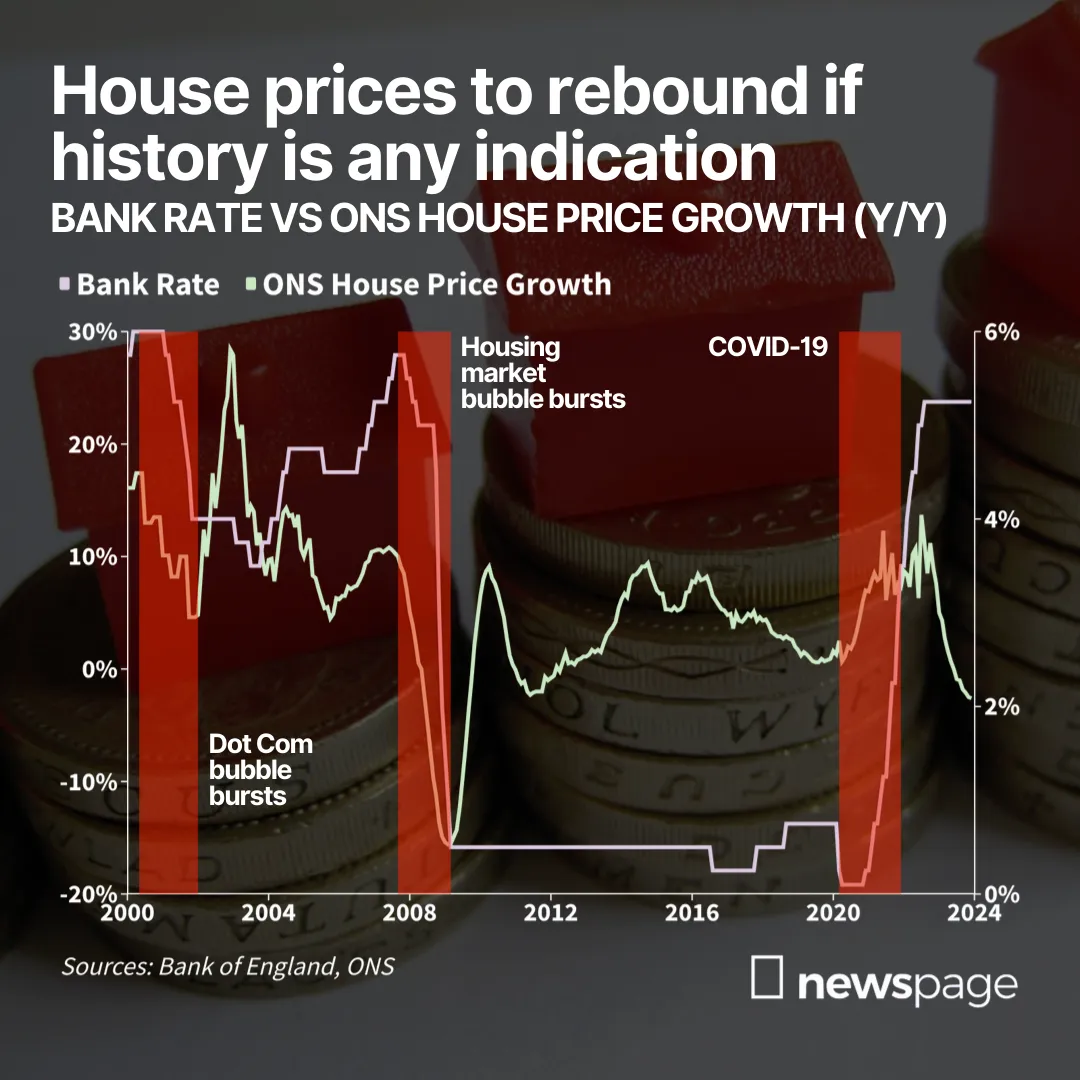
With the first Bank Rate cut set in motion last week, this now begs the question of what this could mean for the future of house prices. Given that the bulk of home purchases are reliant on a mortgage, this should naturally bode well for house prices, as the expectation is that more people can now afford to borrow money in order to buy a house. Hence, it's no surprise to see the inverse relationship between the Bank Rate and house price growth over the past two decades.
There are, however, exception to this trend. Most notably, these tend to occur during recessions or big economic shocks. These can be seen following the implosion of the Dot Com and housing market bubbles in 2001 and 2008, as well as the COVID-19 pandemic in 2020 and 2021.
As such, it's not always a guarantee that house prices will go up every time interest rates drop, as the reasons for rates dropping may be instigated by a recession or recession risks. That said, the odds of a deep recession hitting the UK look to be slim for the time being. Q1 GDP growth (0.7%) was the UK's strongest quarter of economic growth (ex. pandemic) since Q3 of 2019. More encouragingly, the Bank of England (BoE) even doubled its GDP forecast for the year, as it now projects annualised GDP to come in at 2% in Q4 this year, a level not achieved in more than half a decade (ex. pandemic).
On that basis, house prices should continue to rise in H2, as the winds seem to be blowing in the right direction. The latest Nationwide House Price Index just reported that the average house price grew by 2.1% in July, finally breaching the 1% threshold, and saw the fastest growth rate since December 2022.
The cost-of-living crisis is showing signs of dissipating as well, with inflation now back to the BoE's 2% target, and real wage growth still positive. This is encouraging considering the fact that wage growth continues to outpace house prices, allowing for the average house price to earnings ratio to remain at 2019 levels. Consequently, both consumer and business confidence have continued to rebound over the past few months.
But perhaps most crucially, appetite for home buyers remains healthy. Taking into consideration that mortgage approvals have a pretty successful record in rising after an election as well, the starts are aligned for the housing market for the rest of the year. In fact, current forecasts see mortgage approvals rising to as much as 63k by December. This would mark a c.5% rise in approvals, which is consistent with our research, which found that mortgage approvals rise an average of 4.4% in the 3 months after an election.
What's more, mortgage lenders are now reintroducing higher loan-to-value products onto the market and reducing mortgage rates. This could have further scope for reductions, especially if services inflation cools more than forecast, thereby triggering more rate cuts. Thus, with inflation cooling rather than a recession driving potential future rate cuts, annualised house price growth could potentially even reach as high as 5% by the end of the year.
A list of responses from industry experts can be found below.