
Does the Bank of England need to revise its 2% inflation target?
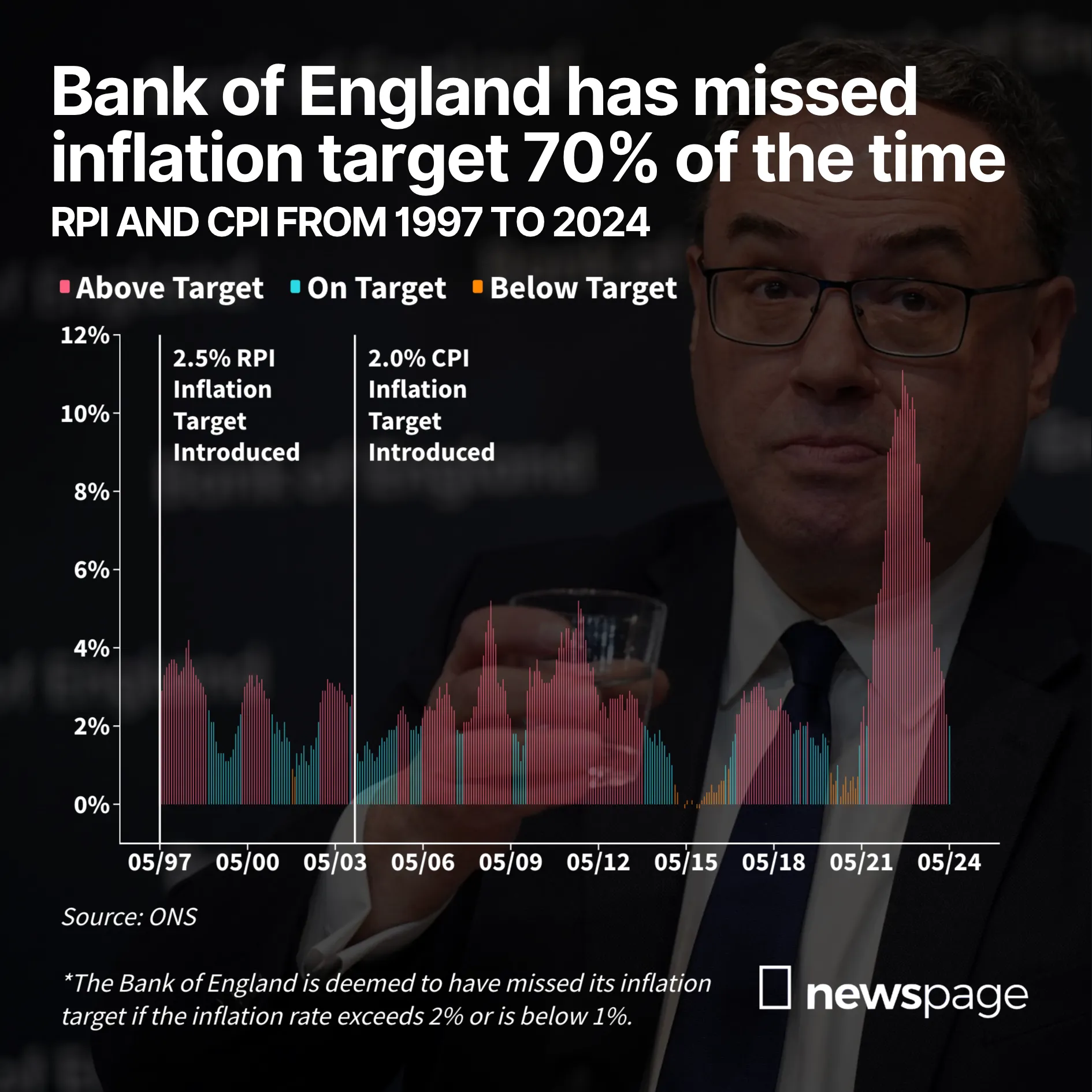
An analysis of Bank of England data by Newspage has found that the Bank of England has only managed to keep inflation at the 2% (more specifically, between 1% and 2%) target 30% of the time since it gained independence in 1997.
The graph above shows the record the Bank of the Bank of England over the past 27 years, with inflation running above and below target most of the time. Of course, some of these instances were down to factors outside their control, such as the Global Financial Crisis (GFC), but it also begs the question of whether it should adopt a more flexible inflation target as a result.
While 1-2% is widely seen as the ideal range in order to maintain price stability, sticking to such a textbook figure may be a fool's game given how susceptible the UK's economic growth has been to geopolitical affairs. After all, there have been several instances where inflation was allowed to run above target in order to spur economic growth, with the Bank even lowering rates in several instances.
Such examples include the 14 months between November 2002 and December 2003, where the Retail Price Index (RPI) ran above the BoE's 2.5% target then. In fact, the Monetary Policy Committee (MPC) opted to even reduce the base rate from 4.0% to 3.5% through the course of this mini inflationary cycle due to fears of potential deflation from the Dot Com bubble bursting a couple of years prior. This strategy was used again during the 2008/09 GFC, when interest rates plummeted from 5.75% to 0.5% while above-trend inflation ran its course from October 2007 to May 2009, as GDP growth was negative for great swaths of this period.
Not only that, the MPC also let inflation run above its 2% target for 4 straight years between December 2009 to November 2013, leaving interest rates at virtually zero — 0.5% in order to support the economic recovery after the GFC. It's also important to keep in mind that services inflation ran as high as 4.9% during this period — still some distance, although not egregiously far from today's figure of 5.7% either. In addition to that, headline inflation ran above target for almost 2 years from February 2017 to December 2018, with policy makers taking 9 months to increase the base rate from 0.25% to 0.75% as they were unsure about the economic impact of Brexit.
This goes to show how susceptible the UK's inflation basket is to geopolitical factors, like energy prices and trading agreements. As such, this opens up a discussion on whether Threadneedle Street should ditch its 2% inflation target and revise it to adopt a more flexible target that takes economic growth into account instead. With this in mind:
- Should the Bank of England ditch its 2% inflation target?
- If so, how should they approach inflation and balance it with economic growth while maintaining price stability?