
Copy article

Cloudflare down again?

ended 05. December 2025

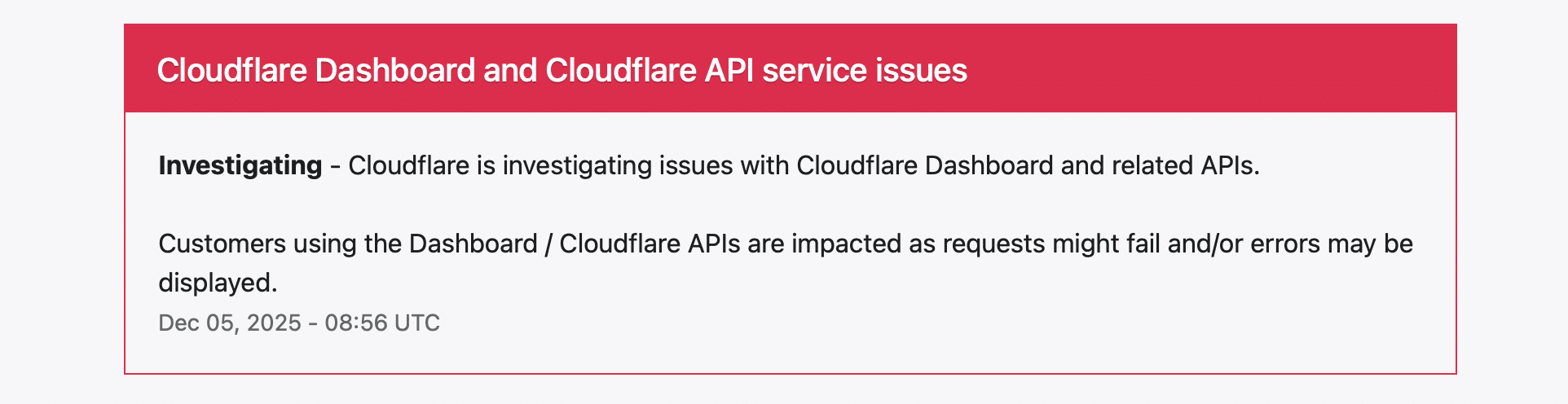
Cloudflare appears to be down again this morning. Have you experienced any downtime and what does this (yet again) say about how exposed the global economy is to a few selected tech players? How can we prevent this from continually happening?
4 responses from the Newspage community

Copy all

Copy

If Cloudflare can be ‘100% uptime’ and down twice before Christmas, I would hate to see their idea of unreliable.
Cloudflare going down again just hammers home the same point for small businesses: if one provider wobbling can take out your site, your bookings and your payments, you are far too exposed. Their SLAs offer credits, not cash, and credits do not pay wages or calm angry clients.
The only real defence is owning as much of your customer access as you can: your mailing list, your phone lines, your socials, and a backup way to take money if your usual setup falls over. When the big boys fall flat, the only thing that keeps you trading is what you control, not what they promise.
Copy

A handful of tech giants now hold the global economy together with digital duct tape, and every outage reminds us how fragile that bargain is. When one firm sneezes, thousands of businesses lose income, credibility and customer trust in real time. Including my own. For SMEs it’s not downtime, it’s lost sales. For regulated sectors it’s operational risk. For the wider economy it’s a warning that centralisation has gone too far. Resilience won’t come from press releases about redundancy. It comes from breaking the dependency on a tiny circle of infrastructure gatekeepers. Until we do, the internet will keep proving just how close we are to a single point of failure.
Copy

Another month, another 'Internet Meltdown'. We must stop acting surprised when these black-box behemoths trip and take half the digital world down with them. We’ve spent a decade chasing hyper-efficiency, stripping away redundancy to save pennies. The result? We’ve consolidated the internet's backbone into the hands of three or four players. When Cloudflare sneezes, the global economy catches a cold.

The problem isn’t just technical; it’s a failure of corporate strategy. Boards love the 'one-stop-shop' promise because it looks neat on a spreadsheet. But today proves, yet again, that efficiency without resilience is just fragility in disguise.

If your entire business model collapses because one vendor pushes a bad update, you don’t have a tech problem, you have a risk management crisis. Stop treating these platforms as infallible utilities. Build multi-vendor systems that can survive a bad day. Resilience costs money, but downtime costs more.
Copy

You could be wondering why do companies Use Cloudflare if it keeps going down?

Speed. It stores copies of websites on servers in hundreds of cities globally, so a user in Tokyo loads content from Tokyo, not London, slashing load times times.

Security: It sits in front of a website like a nightclub bouncer, hiding the real server address and blocking hackers or bots before they can even knock on the door.

Reliability: It handles the internet’s phonebook (DNS) to ensure visitors find the site instantly, and can even show a "saved" version of a page if the company's main server crashes.

Cost: It filters out junk traffic and compresses data, meaning companies pay significantly less for bandwidth and server power.

But when Cloudflare stumbles, that protection becomes a prison. Instead of a fast, secure site, the world is greeted by a wall of "500 Internal Server Error" and "503 Service Unavailable" messages, instantly locking customers out and bringing business to a dead halt.