
Copy article

Bank of England has hit inflation target just 30% of the time since 1997

ended 01. August 2024

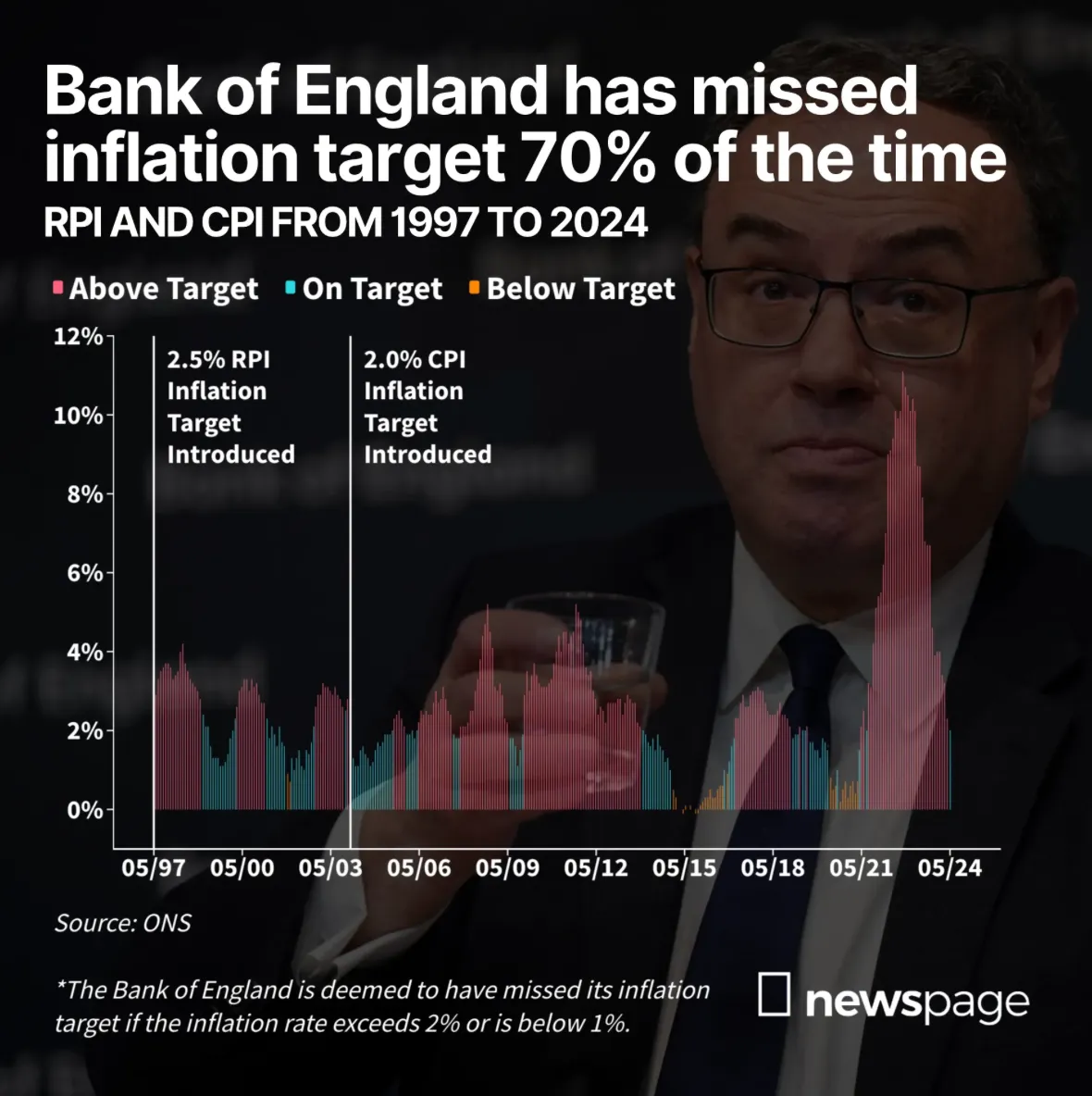
Analysis shows that the Bank of England has only managed to keep inflation at its target rate of 2% (more specifically, between 1% and 2%) 30% of the time since it gained independence in 1997.

During the past 27 years, inflation has been running above and below target most of the time. Of course, some of these instances were down to factors outside of the central bank's control, such as the Global Financial Crisis (GFC), but it also begs the question of whether the Government should set a more flexible inflation target.

While 1%-2% is the global consensus in order to maintain price stability, sticking to such a rigid range may no longer be appropriate given how susceptible the UK's economic growth and inflation basket is to geopolitical affairs.

After all, in several instances, inflation was allowed to run above target in order to spur economic growth, with the Bank even lowering rates at times.

Such examples include the 14 months between November 2002 and December 2003, when the Retail Price Index (RPI) ran above the BoE's 2.5% target at that time.

In fact, the Monetary Policy Committee (MPC) opted to even reduce the base rate from 4.0% to 3.5% through the course of this mini-inflationary cycle due to fears of potential deflation from the Dot Com bubble bursting a couple of years prior. This strategy was used again during the 2008/09 GFC, when interest rates plummeted from 5.75% to 0.5% while above-trend inflation ran its course from October 2007 to May 2009, as GDP growth was negative for great swaths of this period.

Not only that, the MPC also let inflation run above its 2% target for four straight years between December 2009 to November 2013, leaving interest rates at virtually zero (0.5%) in order to support the economic recovery after the GFC. It's also important to keep in mind that services inflation ran as high as 4.9% during this period.

In addition to that, headline inflation ran above target for almost two years from February 2017 to December 2018, with policy makers taking nine months to increase the base rate from 0.25% to 0.75% as they were unsure about the economic impact of Brexit.

This goes to show how susceptible the UK economy is to geopolitical factors, like energy prices and trading agreements. It also opens up a discussion on whether Threadneedle Street should be relieved of its 2% inflation target and given a more flexible mandate that takes the country's current economic and geopolitical circumstances into account instead.

10 responses from the Newspage community

Copy all

Star Quote
Copy

The Bank of England are striving to hit a target that pre-dates the Nokia 3210. It's baffling, especially given the shockingly low success rate. Our economy is much more robust and diverse than it was in the nineties. We do much more business globally, which makes us susceptible to events around the world. A 'one-size-fits-all' 2% target is no longer practical or fit for purpose. We need targets that are constantly under review. 1997 saw Titanic taking cinemas by storm and the Bank of England gain independence, but it feels like a lifetime ago. We need to move with the times.
Star Quote
Copy

Only hitting the inflation target 30% of the time demonstrates how archaic the correlation between the inflation target and the actions of the Bank of England have become. A target should at least be relevant and reviewed regularly for our needs as a country, not a blanket approach left, for the best part of 30 years, untouched. We seem to be focused on economic theory rather than practice.
Star Quote
Copy

You don't need a degree in economics to see that setting a target range rather than a single number as an inflationary or price target would make much more sense for the Bank of England. A target range of 2%-3% annualised seems much more of a logical way to deal with something as volatile as prices. We also shouldn't forget that it's our esteemed governement that set this arbitary number as an inflation target. This was part of the deal when Blair's Labour government gave the Bank of England its independence.
Star Quote
Copy

Whatever metric you use to assess its performance, the Bank of England has failed. It started hiking rates too late, then raised too sharply and is now in danger of not easing rates soon enough. The notional 2% target was always as irrelevant as the reasoning behind it. With so many factors that influence the overall inflation figures, using it as the main yardstick for determining the Base Rate is inefficient at best. The Bank of England raised the rate needlessly, as it was trying to fight the wrong type of inflation with the wrong weapon. It took a bazooka to a knife fight. The Bank of England should make decisions based on the needs of the whole economy, starting with a 0.25% reduction on 1st August.
Copy

The current format is long overdue a change. The dynamics of inflation and the factors that have an effect on it have changed dramatically over the years, rendering the current arrangement null and void. Furthermore the members of the MPC seem so far removed from the general population and the struggles they face that they should not have such power at their fingertips.
Copy

The Bank of England hitting its 2% target just 30% of the time since 1997 is hardly a stellar record. It seems like relying solely on changing interest rates to control inflation is akin to trying to steer a ship with just a paddle. Modern economies are complex beasts, and we need a more nuanced approach than simply setting a target. Perhaps it's time for the Bank to rethink its strategy, balancing inflation control with economic growth and stability? After all, in the ever-changing economic landscape, it's not just about hitting a number but ensuring a thriving economy overall.
Copy

Based on this analysis, it's clear that the Bank of England has failed to keep inflation in check over the last 27 years, but no one can be surprised by this as it has a tradition of being too slow to react, often once the inflation horse has bolted. The two problems are that economies and technology have moved on so much that often waiting for a month to see what's happened means you are often left behind. Secondly, a single target never works. The Bank of England should be focused on hitting a balanced scorecard of metrics, with inflation being just one of a suite of 3 or 4 metrics that reflect the dynamic world we live in today.
Copy

We are a nation that fears change. A target is exactly that and not a necessity. If a stat says you are wrong more than right then something needs to change as it’s clearly not working. Admitting you are wrong and trying something else is something that may be needed: we need that now. Just because it’s the way it’s always been done doesn’t mean it's the way it always should be. The Bank of England need to show a maverick approach and cut the base rate on 1st August as consumer confidence is already running low with them.
Copy

We need a target so inflation doesn’t run away but the measures being taken to meet that target clearly don’t work. Something needs to change and better parameters put in place to act on economic challenges instead of simply reacting.
Copy

The idea that the Bank could keep inflation bang on 2% month-after-month is farcical. The 2% target is set by the Government and not the Bank, so it is the Chancellor of the Exchequer that needs to look at this and make an amendment to the task they are asking the MPC to achieve. An acceptable range of inflation would make far more sense and allow the Bank to be more effective, keeping inflation between 1% and 3% for example, would be more useful in the real world.