
Copy article

Warning about product reviews as survey finds over 82% of Brits trust online reviews

ended 24. March 2026

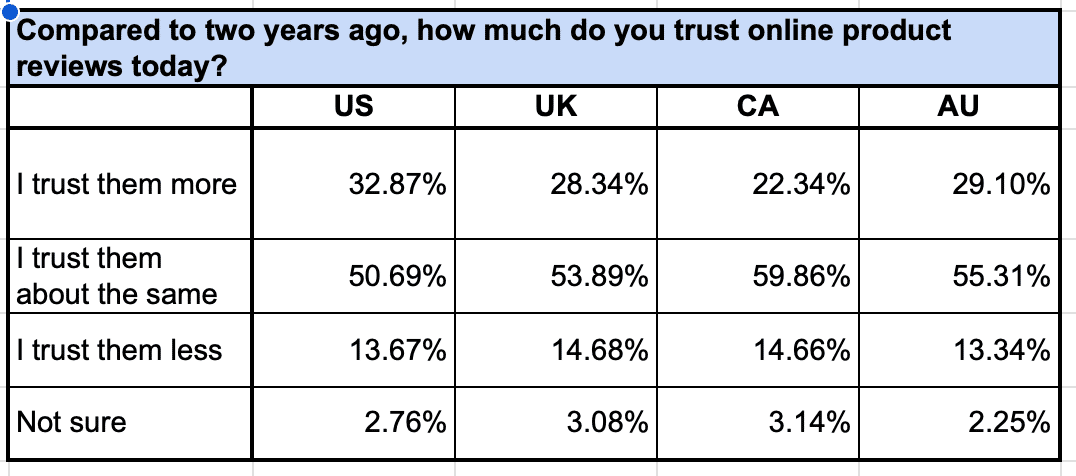
Omnisend research has found over 82% of Brits trust online product reviews the same, or more, than two years ago.

But this comes as TruthEngine data shows over 50% of online reviews are now fake or AI-generated.

  • Why do so many people believe in online product reviews when the evidence suggests so many are bogus?
  • Do you have any examples of buying a product with a high review score, but found out it was an awful product when you received it?
  • Do you naturally believe the reviews you see online? Or are you sceptical?

Responses by tomorrow.
 

6 responses from the Newspage community

Copy all

Copy

The 2026 "authenticity crisis" highlighted by TruthEngine shows why scepticism is essential. That's why I only use sites that publish verified reviews, like Trustist, to help overcome our innate human biases. We are, after all, social creatures. Seeing hundreds of five-star ratings triggers a kind of herd mentality — if that many people bought something, surely it can't be bad? In today's marketplace, we're also increasingly vulnerable to decision fatigue. Faced with thousands of near-identical products, our brains reach for heuristics — mental shortcuts that simplify complex choices. A star rating is far easier to process than researching a manufacturer's entire history.
Copy

It’s frustrating that so many reviews are now fake or AI-generated, yet trust remains high. In holiday lets, reviews are the heartbeat of bookings, and ours are 100% from real guests. That social proof matters, so it’s galling to see others dressing up fiction as fact and diluting genuine feedback; that erodes trust for everyone.

Personally, I’m naturally sceptical, especially when reviews feel too polished or sit within website graphics rather than verified platforms. I’ve been caught out myself by a jewellery cleaning gadget that promised sparkle and delivered a glorified vibrating bath. It was all promise and no performance. Reviews still reassure, but it’s increasingly a case of buyer beware.
Copy

82% trust in reviews is fuelling a fake-feedback frenzy, where five-star systems are fast becoming five-star scams. Online reviews have followed influencers down the same slippery slope — what started as real voices has been rapidly replaced by paid praise and AI-written approval. More than half being fake isn’t just a tech problem, it’s a trust trap most shoppers don’t even realise they’re in. In my own work vetting AI tools, reviews are the last thing I check because they’re the easiest thing to rig, yet most people treat them as gospel. Until people learn to follow the money behind the stars, Britain’s buying habits will keep being gamed.
Copy

As social animals, humans are naturally drawn to what others think, but it’s the system that is encouraging this behaviour in less-than-honest businesses. Reviews on products are a ranking factor when it comes to getting your product or service to sit head and shoulders above others in your pack. So it’s unsurprising that reviews then become a commodity - and where you have a commodity, you have a service that can be sold to create those reviews for you. The average small business has only a handful of reviews, if any at all, and in the meantime Google My Business has declared that businesses with 1,000 reviews and over will be prioritised in listings. The natural consequence of this is to fix the problem by getting more reviews - by fair means, or foul.
Copy

82% of people trust reviews as much or more than two years ago. Over half are reportedly fake or AI generated. Those two facts can't comfortably coexist.

People trust reviews because they work as a shortcut. Nobody researches every purchase from scratch, so stars and comments become a proxy for quality. That's rational in a system that used to be mostly honest. The problem is the system changed and the habits didn't. Fake reviews don't look fake anymore. AI generated text reads like a real customer with a real opinion.

This isn't a consumer stupidity problem. It's a platform accountability problem. Amazon, Google, and Trustpilot all profit from review volume. Their incentive is more reviews, not better ones. Until platforms face consequences for hosting manufactured trust at scale, telling shoppers to "be more sceptical" is asking individuals to do quality control the platforms refuse to fund.
Copy

People trust reviews because they are a comforting shortcut. When you are tired, scrolling on a phone, a 4.6 star score feels like evidence, even if it is just marketing wearing a lab coat.

Fake and AI generated reviews work because the incentives line up. Sellers can buy social proof cheaply, platforms want conversion, and most buyers do not have time to read beyond the headline. Trust also lags reality: people remember the one time a review saved them, and forget the ten times it was noise.

In our AI audits, we keep seeing the next problem: retailers using AI to summarise or "clean up" reviews without keeping provenance. That makes it harder to spot bots, copy paste patterns, sudden rating spikes, and coordinated refund-for-five-stars campaigns.

Practical tip: read the 2 and 3 star reviews, look for specific flaws, and be wary of perfect language that sounds like a brochure. If you cannot tell who wrote it and when, treat it as an advert.