
Copy article

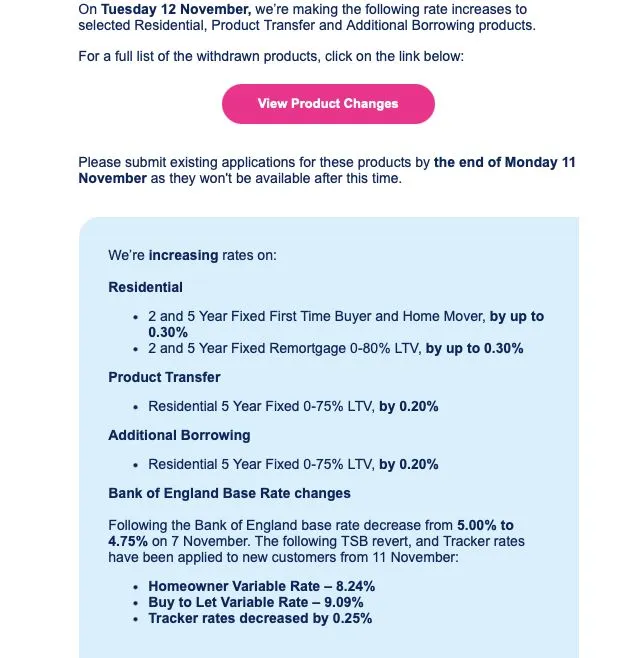
TSB increases fixed rates by up to 0.3% "due to the rising cost of funding"

Journalist: Justin Moy, Contributing Editor

ended 11. November 2024

Despite the base rate being cut to 4.75% last week, TSB is the latest lender to increase fixed rates by up to 0.3% this morning. Brokers said this is likely due to the rising cost of funding as a result of the Labour Budget and Trump election win. One said: “While the base rate has improved, borrowers need to understand that this does not directly price the majority of mortgage products. Instead, it is the longer-term outlook for the cost of funds through Swap rates and Gilts that mortgage holders need to keep an eye on.” The views of brokers can be found below and will keep appearing until 11am.
 

8 responses from the Newspage community

Copy all

Star Quote
Copy

This is another case of buyer beware. Despite the Bank of England cutting rates by 0.25%, lenders are increasing them, the latest one being TSB. Borrowers need to understand that Threadneedle Street cutting rates does not necessarily trickle down to lender rates, and not necessarily in a timely manner either. Lenders are at the behest of swap rates and have usually already priced in predicted rate cuts so their products don't have to fall in line. Trackers might seem like an attractive proposal but they are still really overpriced and 5-year fixed rates remain the cheapest rates out there.
Copy

TSB is the latest lender that has had little option but to increase rates due to the rising cost of funding, which has been largely fuelled by the Labour Budget. While the base rate has improved, borrowers need to understand that this does not directly price the majority of mortgage products. Instead, it is the longer-term outlook for the cost of funds through Swap rates and Gilts that mortgage holders need to keep an eye on. We are unlikely to see wholesale cuts in fixed rates for some time yet, as the markets factor in the US election result along with our own country's high spending plans.
Copy

It’s disheartening to see lenders increasing rates, especially as swap rates are reducing. I’m hopeful that over the course of this week we will start to see lenders reduce and conditions slowly begin to improve for borrowers.
Copy

Many borrowers will be left scratching their heads as to why, less than a week after the Bank of England cut the base rate by 0.25%, lenders like TSB are increasing fixed rates. The markets are still feeling the aftershocks of the Labour Budget. Although it wasn’t as disastrous as the mini-Budget, the longer-term cost of borrowing continues to rise. Gilt yields and SWAP rates are reacting not only to budgetary policy but also to geopolitical uncertainties, including Trump’s re-election to the White House. Anyone holding out for big cuts in interest rates is taking a gamble for now.
Copy

Mixed mortgage messaging from lenders can cause borrower confusion as they don't understand the pricing. Borrowers will expect mortgage rates to come down and not go up following the base rate decrease. As swap rates and Gilts continue to decrease, the increase in rates for TSB is a little puzzling.
Copy

TSB start the week as most lenders will probably end it with rates rising like a slowly building tidal wave, washing away all the positive vibes of the Bank of England base rate cut. This is unsurprising to all involved in the mortgage market, as swap rates remain volatile and lenders have had no choice but to consider the cost of funding and how best to manage the current climate. The UK Budget and now the US presidential election both created volatility, which could impact mortgage rates both in the short and long term. First-time buyers should carefully assess their affordability and factor in the possibility of future rate rises when determining their budget and borrowing capacity. It's essential to work within comfortable affordability limits and avoid overextending financially. If there is one thing that is certain with the UK mortgage market, it is that it will remain inconsistent.
Copy

The yo-yo-ing rate and product changes of late have borrowers' and brokers' heads in a spin. Yet for many mortgage customers, the comfort of a fixed outgoing is still preferable to taking a risk in a volatile market. It’s about personal choice of course, but borrowers need to have their wits about them.
Copy

Following the Bank of England’s recent rate cut, TSB's decision to raise its mortgage rates highlights the mixed messages currently shaping the mortgage market. For those considering a new mortgage, the landscape is tricky—TSB’s move adds complexity, especially as many other lenders are re-evaluating their rates. While tracker rates may seem more appealing given the potential for further rate cuts, there’s no guarantee. Fixed rates provide stability but at a cost. With uncertainty in the air, it's essential for borrowers to weigh the risks of rate fluctuations against the security of a fixed option, particularly with lenders shifting cautiously in response to broader economic changes.