
Pound for Pound: markets betting on further cuts might not pay off
For the first time in 52 months, the Monetary Policy Committee (MPC) finally cut interest rates to 5%. Financial markets are now pricing in as many as two more rate cuts for the rest of the year. As a result, gilt yields (a leading indicator for mortgage rates) continued to trend down, and are now in range of a year-to-date low. However, the Bank of England's (BoE) forecasts for inflation and economic growth could present a roadblock for the slew of rate cuts coming from lenders as of late. This could lead to a potential slowdown in the mortgage rate-cutting cycle going into the autumn, especially if inflation proves to be hotter than forecasts.
Bank staff continue to see headline inflation trend above target for the rest of 2024. This was always their base case. However, they now estimate the Consumer Price Index (CPI) to peak higher than stated in their previous Monetary Policy Report. In this instance, headline inflation is now expected to peak at 2.7% in Q1'25, rather than the 2.6% expected in the May report. This is down to stickier services inflation than initially estimated.
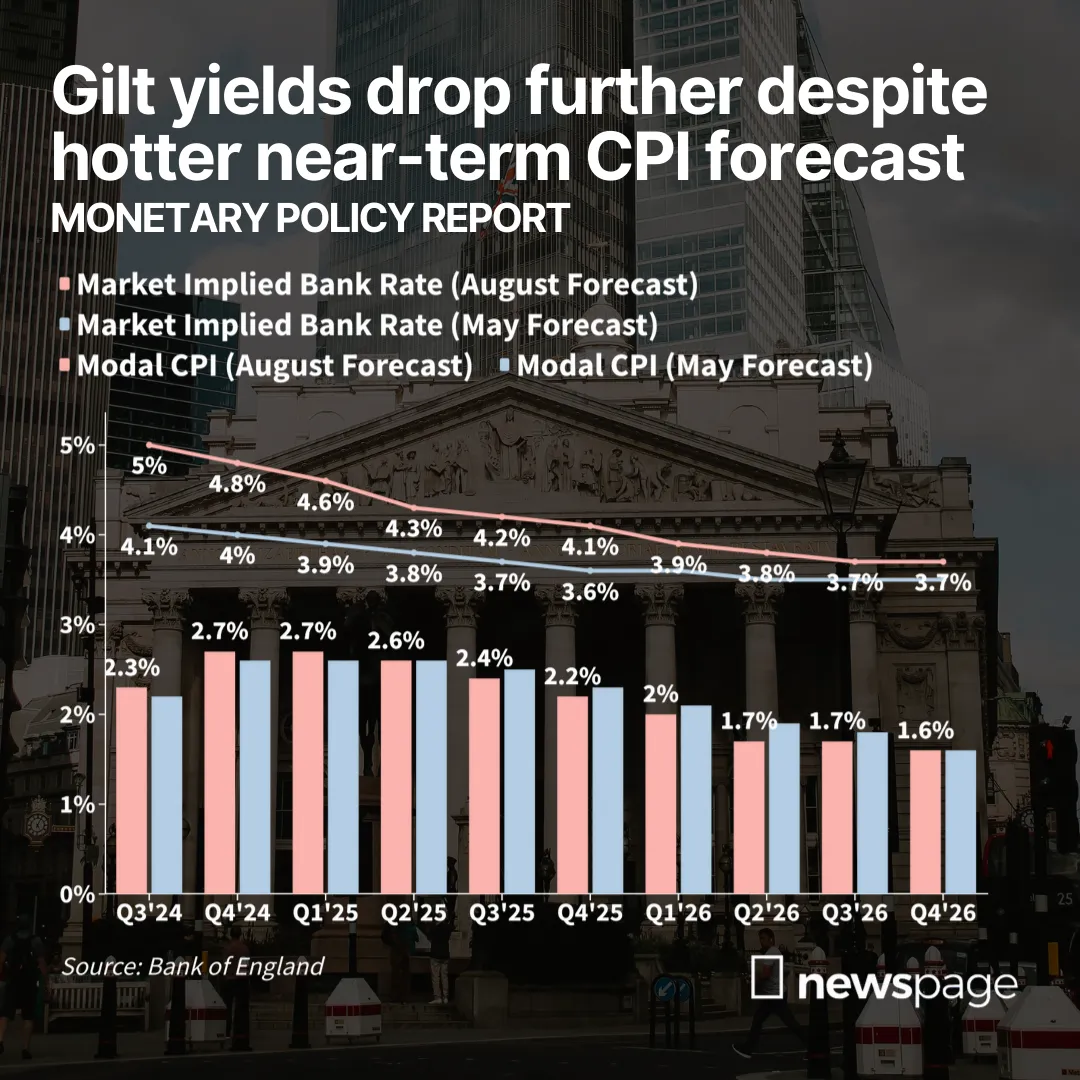
Considering how big of a factor services CPI is to the MPC's decision-making process, this will be the linchpin for where the housing market heads in the coming months. Having previously projected services CPI to drop to 4.7% by September, the new forecast doesn't look pretty, as members only foresee it dropping to 5.5% by then, and only to 5.3% by December. This is a far cry away from the pre-pandemic average of 3% that's consistent with 2% headline inflation.
Aside from that, the BoE have upgraded their annual GDP growth rate. They now predict the economy to grow more than previously forecasted for the rest of the year, with Q3 (1.5% vs 0.5%) and Q4 (2.0% vs 1.1%) GDP growth approximately double of what had been disclosed in May's report.
The labour market is also set to remain tight, with unemployment not budging above 5% for the foreseeable future. Although, it's worth noting that there's a disconnect between market expectations and the Bank's estimates, with the latter seeing a huge potential uptick in unemployment to as high as 5.7% by the end of 2026.
Be that as it may, a silver lining remains — this was Jonathan Haskel's (the MPC's most hawkish member) final meeting. This means that the committee will be going into its next meeting with one less hawk. Therefore, September's meeting may look more encouraging for those clamouring for more rate cuts, as a vote split down the middle would ultimately be decided by the Governor himself, Andrew Bailey, who voted for a cut today.
Still, Bailey stated on the press conference that the MPC are likely to keep rates at a restrictive level for longer in order to eradicate the sticky elements on services and pay inflation. Thus, judging by the central bank's outlook for services inflation, the case for more rates cuts may be put on pause for the time being.
The Governor also mentioned that committee members are unlikely to cut too heavily or quickly, which could see markets getting too ahead of themselves once again, just as they did earlier this year. Nonetheless, the proof will be in the pudding, with two inflation prints before the next MPC meeting.