Mortgages for dentists: how much can associates, principals and newly qualified dentists borrow?
By Gabriel McKeown, Head of Research, Newspage ·
Most mortgages for dentists are offered at around 4 to 4.5 times income, with professional mortgages stretching to 5.5 times or more, including for newly qualified dentists.
However, most lenders assess associate dentists on two years of net profit, after lab fees and expenses, which brokers warn can make a dentist billing £150,000 a year look like a £70,000 earner.
Mortgage brokers told Newspage that dentists are "generally very mortgageable", but that a mix of NHS, private and self-employed income means "two dentists earning the same amount can end up with very different borrowing figures".
Brokers said some lenders will instead work from an associate's contract or average three to 12 months of invoices, so newly qualified and newly self-employed dentists may be able to buy sooner than they expect.
How do lenders assess an associate dentist's income?
Most associate dentists are self-employed. Their income typically combines NHS work, measured in units of dental activity (UDAs), with private fees, and lab costs are deducted along the way.
Toby Quanstrom, Director at Eastbourne-based Quanstrom Financial, said standard self-employed rules can make an associate invoicing £108,000 a year look like a £58,000 earner.
He added: "Most lenders apply standard self-employed rules to dentists: two years' tax calculations, averaging net profit after expenses.
"Some lenders will instead average three, six or 12 months of gross invoices, NHS UDA and private work together, deducting lab costs, without two full years of accounts.
"At 4.5 times income, that is roughly £486,000 rather than £261,000, and some lenders may go up to 6.5 times income for dentists.
"So newly self-employed associates may not need to wait. Principal dentists are assessed differently, usually on salary plus dividends, and with a minority of lenders on salary plus their share of company profit.
"The most common mistake? Going straight to the high street bank and being assessed on tax returns by default."
How much can dentists borrow?
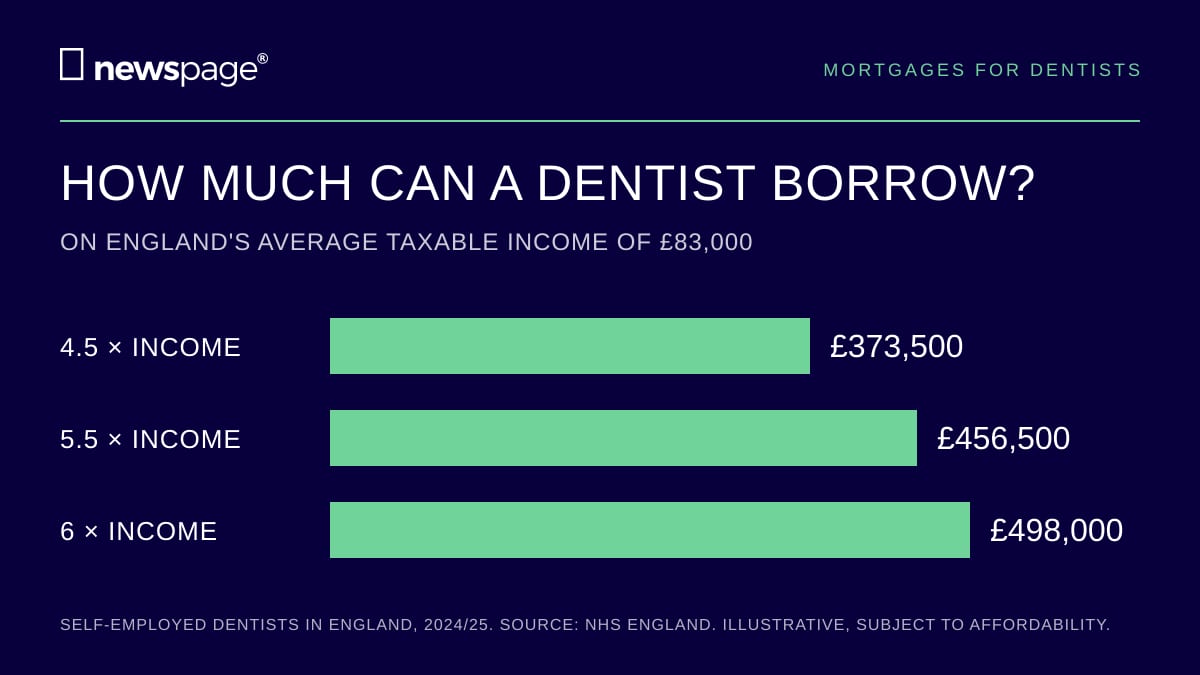
Self-employed dentists in England had an average taxable income of £83,000 in 2024/25, up 6.1% on the year, according to NHS England.
Most standard mortgages lend around 4 to 4.5 times income, but some professional mortgages for dentists go further.
Kensington Mortgages lends to dentists at up to six times income and up to 90% loan-to-value. Metro Bank also offers up to six times income to dentists who qualified in the last ten years.
A dentist on England's average taxable income of £83,000 could borrow about £373,500 at 4.5 times income, £456,500 at 5.5 times and £498,000 at six times.
Louis Mason, Content and Communications Director at London-based Oportfolio Mortgages, said: "Dentists often earn well but don't always fit neatly into traditional mortgage criteria. Associate dentists typically receive income from NHS UDA payments and private fees, with lenders assessing tax returns, contracts, invoices or recent earnings differently.
"Most can expect borrowing of around 4 to 4.5 times income, although some professional mortgage products offer 5 to 5.5 times, subject to affordability. While many lenders require two years of self-employed accounts, specialist lenders may consider newly qualified dentists or those with just one year's figures.
"Practice principals face additional scrutiny around business profits, salary, dividends and potentially retained earnings.
"The biggest mistake is assuming a high income guarantees a straightforward application. Two dentists earning £120,000 could receive very different mortgage offers simply because lenders interpret their income differently. Choosing the right lender is often more important than the headline rate."
Can newly qualified or newly self-employed dentists get a mortgage?
Newly qualified dentists usually spend their first year in dental foundation training, then move into an associate role and become self-employed. This is the point at which many high street lenders ask for two years of accounts, even as earnings rise sharply.
Elliott Culley, Director at Hayling Island-based Switch Mortgage Finance, said: "I find the biggest issue for dentists looking for a mortgage is affordability, as most dentists start looking for a mortgage after they have recently moved to an associate role at a practice and become self-employed.
"The money earned increases substantially, but the issue for high street lenders is wanting at least two years' worth of self-employed figures. Some dentists then put off buying for a year or two.
"However, there are mortgage lenders that understand this and can either look at the contract you have with the practice or look at the invoice or remittance slips you receive from the practice on a monthly basis.
"Provided the contract has a monetary value, for example a minimum amount of UDAs per year, some lenders can use the value of this to determine how much you can borrow.
"If your contract does not have this, or you need to utilise more income, a lender who can use the invoices may be more suitable. A three to six-month average can be used to determine your affordability."
How are practice principals and limited company dentists assessed?
Practice principals who trade as sole traders or partners are usually assessed on their share of practice profit, while those trading through a limited company are assessed on salary and dividends.
A minority of lenders will also count the director's share of company profit, including profit retained in the business, which can make a significant difference for principals who draw a modest salary.
Brokers said a year of heavy investment, such as new equipment or a refit, can push profit down on paper, and that many lenders will take those costs into account.
Ria Ali, Director at PMS Mortgages, said: "A dentist billing £150,000 can look like a £70,000 earner to a mortgage lender. Associates are usually self-employed, so most lenders work from net profit on SA302s, after lab fees and expenses, whatever the split between NHS UDAs and private work.
"Certain lenders offer professional mortgages at 5.5x income or more, even to newly qualified dentists and locums. Many dentists assume they need two years' accounts first, and they often don't: certain lenders will consider a foundation contract, one year's figures or a locum's recent work.
"Principals are assessed on their share of practice profit, limited company owners on salary and dividends, though some lenders consider retained profit.
"We also help practices with a bad year on paper due to justifiable business costs, such as new equipment or a refit, which many lenders will take into consideration.
"The costliest mistake? Assuming specialist means expensive. The lenders specialising in dentists are mainstream, with fantastic rates."
What are the most common mistakes dentists make when applying for a mortgage?
Brokers said the most common mistakes are going straight to a high street bank, relying on a standard self-employed calculator, assuming a high income guarantees an easy application and assuming specialist lenders are expensive.
The same income can produce very different borrowing figures depending on whether a lender works from tax returns, a contract or recent invoices, so choosing the right lender can matter as much as the rate.
Stephen Perkins, Managing Director at Norwich-based Yellow Brick Mortgages, said: "Dentists are generally very mortgageable, but their income can be more complicated than it first appears. An associate may have NHS income, private fees and self-employed earnings, while a practice principal could also have income retained within a limited company.
"Different lenders can assess those figures very differently, so two dentists earning the same amount can end up with very different borrowing figures.
"Being newly qualified or recently self-employed does not automatically mean waiting two years either. Some lenders may work from contracts or recent invoices rather than insisting on two full years of accounts, particularly where there is clear continuity in the profession.
“The biggest mistake is assuming a standard self-employed calculator tells the whole story."