How can a business get into Google's AI Overview? What the data and the experts say
By Gabriel McKeown, Head of Research, Newspage · · Updated
A business gets into Google's AI Overview by publishing a clear, sourced answer to a specific question on a page Google already trusts, SEO specialists and business owners have told Newspage.
That matters because nearly 70% of UK Google searches in the first four months of 2026 ended without a click, SparkToro data shows.
They said Google's AI "quotes whoever answers the question first and plainly", but warned that "an AI citation is encouraging; it isn't, by itself, a commercial result".
Many businesses still see Google search as the only way to be found online. This is either by ranking in the organic results, where Page 1 is the target, or through pay-per-click (PPC).
PPC is paying for your ads to appear when people enter searches into Google that are relevant to that search.
However, based on the latest data on how people search, a growing share of Google searches no longer leave the Google results page due to the number of answers written by AI.
Experts told Newspage that the businesses being quoted in AI answer the exact questions their clients or customers ask, clearly and early on the page, with real numbers and a straight answer.
They said long-tail questions are far easier to win than the big generic terms, urged businesses paying an SEO firm to ask for proof that it is getting them quoted in AI search, and warned that leads companies are competing with them for it.
How does a business get into Google's AI Overview?
A business gets into Google's AI Overview by answering a specific question clearly on its own site, with its expertise backed up consistently by other websites, experts said.
Tony Restell, Founder and Director at Social-Hire.com, said: "The key to getting into Google's AI Overview answers is to have a clear area of niche expertise, that's backed up by others talking about your expertise on external websites.
"One big thing that destroys a firm's results is unintended inconsistency across the web.
"If the social media profiles and directory listings you created 5 years ago don't align with what your website says today, Google loses confidence in your true areas of expertise and so doesn't feature you. Address this first, then recode your website to be AI-friendly."
What kind of content does Google's AI quote, and what does it ignore?
Google's AI quotes specific, up-to-date answers to the questions people actually ask, with real numbers, and ignores generic sales pages, experts said.
Ria Ali, Director at PMS Mortgages, said: "People no longer search 'mortgage broker'. They ask full questions like 'Can I get a mortgage if I'm self-employed with one year's accounts?' - exactly where AI Overviews appear.
"The businesses being quoted answer those questions clearly and early on the page, with real numbers and a straight answer, not padding.
"The AI ignores generic 'why choose us' pages and rewards specific, up-to-date answers from people who do the job daily.
"A broker who has placed hundreds of cases knows real lender criteria, and that's what it quotes."
Is SEO still worth paying for, and is your SEO firm getting you into AI search?
SEO is still worth paying for, experts said, as long as the firm can show the business being quoted in AI search as well as ranking in the blue links.
Harry Goodliffe, Director at Winchester-based HTG Mortgages, said Google's AI "quotes whoever answers the question first and plainly, and most mortgage websites never answer anything".
He added: "I do my own SEO, and the pages that get picked up are written the way I'd explain it on the phone: the question in the heading, a straight answer in the first two lines, then the detail.
"And if you pay an SEO firm, ask them to show you one search where you're quoted. If they can't, stop paying."
Ali added: "SEO is still worth paying for, but only if your agency understands ranking in the blue links isn't the whole game.
"Ask what they're doing for AI search - many still sell keyword reports for terms that now get few clicks."
If you pay a leads company, are they getting you found in AI search?
Leads companies are competing with businesses for AI search, experts said, and any business buying SEO or AI visibility services should ask which searches and pages are involved, and what measurable response follows.
Goodliffe said: "Lead companies aren't getting you into AI search; they're competing with you for it."
Tony Sanchez, Founder at Bridging Loan Directory, said: "A citation is different from a visit or enquiry. Businesses buying SEO or AI visibility services should ask which searches and pages are involved, and what measurable response follows."
Should a business target big generic terms or long-tail questions?
A business should target long-tail questions, experts said, as the people making these searches are ready to act, and they are far easier to win than the big generic terms.
Ali said: "Forget chasing big generic terms. Target the long-tail questions clients ask you on the phone, answer them properly on your site and keep those answers current."
Sanchez added: "At Bridging Loan Directory, we've seen our guides cited in Google's AI Overviews, including one comparing refurbishment bridging lenders.
"We start with questions brokers and borrowers ask: can this property be financed? How much is available after interest and fees? What happens if repayment is delayed? We check lender criteria and use practitioner contributions to explain the differences.
"Specific questions give us a clearer editorial purpose than competing for every broad finance term. But we haven't found a formula for AI inclusion.
"SEO still matters to us. The goal is helping the right reader find a useful answer. An AI citation is encouraging; it isn't, by itself, a commercial result."
What the numbers say
Nearly 70% of UK Google searches in the first four months of 2026 ended without a click to a new webpage, according to SparkToro and Similarweb data published in June 2026.
Google's AI Overviews now appear on nearly a third of UK searches, according to Ofcom's Online Nation report, published in December 2025.
When an AI Overview appears, the page ranked first on Google loses 58% of its clicks, Ahrefs found using December 2025 data.
However, being quoted still pays. Brands cited inside a Google AI Overview get 120% more clicks per appearance than brands left out, and AI Overviews now appear on 86% of question searches, which is where users are looking for an expert answer, according to Seer Interactive data covering January 2025 to February 2026.
AI chatbots have also become a search channel in their own right. ChatGPT drew 1.8bn UK visits in the first eight months of 2025, Ofcom found, and its ads business reached a $1bn annual revenue run rate in under 200 days, OpenAI said on 31 August 2026.
Instead of setting up a separate paid ads channel, businesses may find it more effective to become the source that the AI tools actually quote.
What it looks like when it works
The examples below are Newspage's own. Newspage's Storybuilder takes the questions a firm's clients are asking and builds a research-led news story around them, and our Evergreen service checks a firm's own page against the search it should answer.
Newspage's research on private bank mortgages, quoting Aaron Strutt of Trinity Financial first, was submitted to Google at 08:19 on 20 October, the day it was published, and by 11:15 the AI Overview for "private bank mortgages v high street" opened with a line from the story, with Trinity Financial cited alongside it.
This shows a well-sourced story can enter an AI Overview on the day it is published, with no media coverage.
Newspage research sponsored by Oliver Jordan of Check Financial, on what each major insurer pays out for DCIS, an early form of breast cancer, under critical illness cover, was cited seven times in Google's AI Overview for "critical illness cover DCIS" within a day of publication.
This also resulted in Google citing Oliver's own landing page, which went on to become the top result on page 1. Check Financial was the first web result for that search on 7 October, and was still on page 1 when we checked on 27 October, showing the sponsor’s own page can benefit as well as the story.
Philip Dragoumis of Thera Wealth reached first listing on Google UK for "should I sell my RSUs uk" after sponsoring Newspage research, showing the same approach can lift a firm's own page into standard page 1 results. He also featured in the AI Overview.
A Newspage parking fines story in FT Adviser, published in February 2025, still opens Google's AI Overview for "mortgage with a parking fine CCJ" 20 months on, showing that a place in the Overview can hold.
Newspage’s story on whether a bank surcharge would push up mortgage rates was the first result on Google for “will bank surcharge push up mortgage rates” at 11:52 on 27 October, above The Sun, The Telegraph, the TUC and Mortgage Strategy, 13 hours after it was published and before any newspaper had run it. On the broader search “will bank surcharge affect mortgage rates”, it was cited in Google’s AI Overview.
On 28th October at 07:00, it was still informing most of the AI Overview for the related search, ‘bank surcharge effect on mortgages’ (see screengrab).
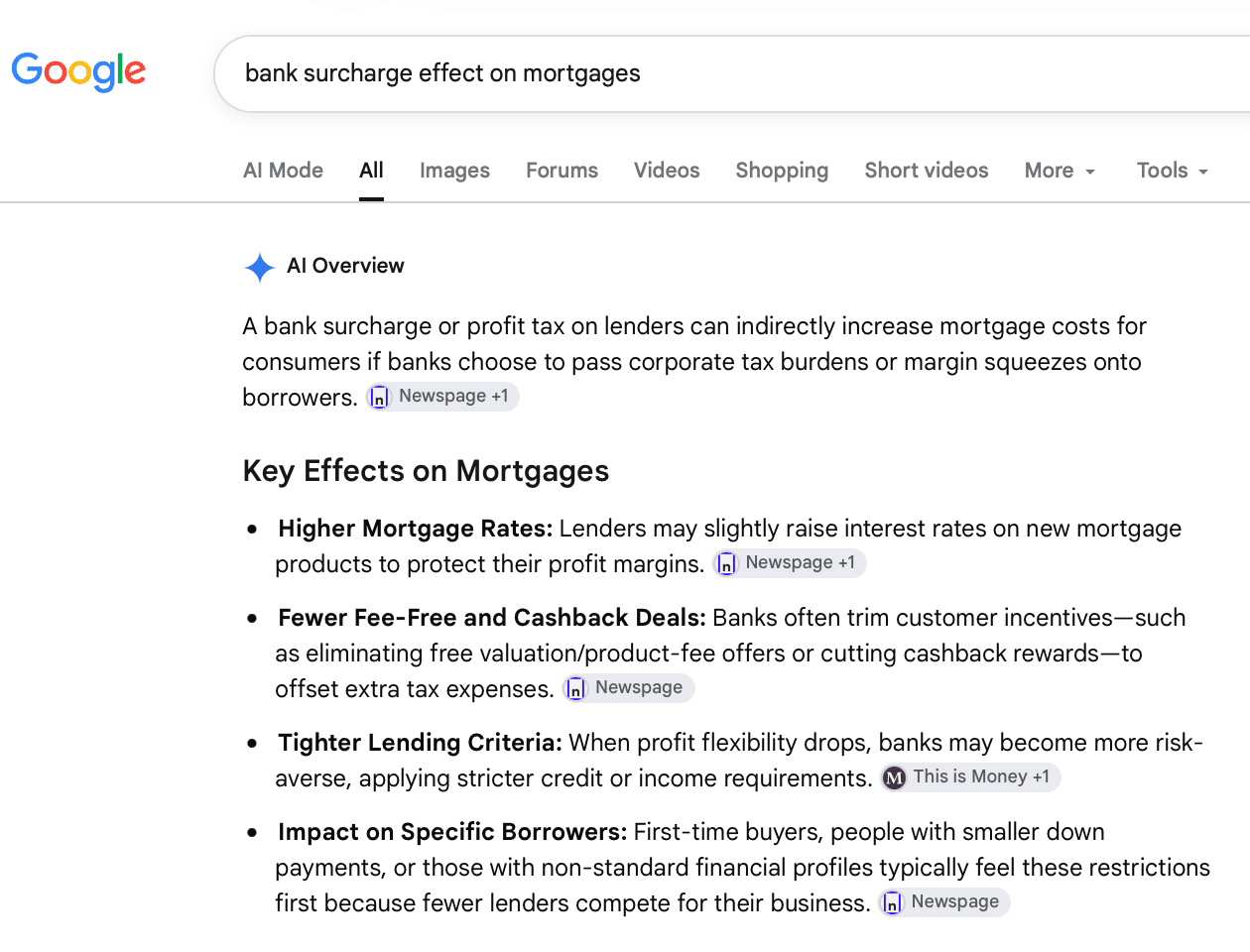
This shows a story can reach the top of the standard results within a day, ahead of national media coverage. It is important to note that nobody can guarantee a place in Google's AI answer, and results change daily.
What's also important is to not try and game Google or create thin pages or fly-by-night content that is backed up by very little.
Create strong and fresh content that answers the questions searchers ask very clearly and with authority, and there's a chance you will make it into the AI Overview.
Getting your business into Google’s AI Overview: your questions answered by Dominic Hiatt, Founder of Newspage.
How do I get my business to show up in Google’s AI Overview?
Answer the exact question your customers search for, clearly and early, on a page with your name on it that makes it easy for Google to understand who you are and why you have authority. Google’s AI quotes the clearest first-hand answer it can find, so put the answer in the first sentence and the detail underneath, use headings that match real searches, and give real figures rather than general reassurance. Then get credible sites, such as news publishers, quoting you, ideally linking to that page (no-follow links are fine, as most publishers won't offer do-follow links anyway). We’ve seen it work fast: a broker’s new fees page was cited in the AI Overview a day after going live. There’s no trick and no way to pay for it. You earn it by being the best answer.
How do I find out if my business is being quoted in Google’s AI Overview?
Search the exact questions your customers ask, in a private or incognito window so your own browsing history doesn’t skew the results. If an AI Overview appears, look at the small source links beside each line, or open the source panel, and see whose names come up. Check the questions that matter most to your business, not your firm’s name, because a search for your own name only proves Google knows you exist. Overviews change from day to day, so check regularly and screenshot what you see, with the date. Over a few weeks you’ll see whether you’re gaining ground. It can be exciting to see new content break through into Google's AI Overview rapidly, and it's also very possible.
How long does it take for a new page to appear in an AI Overview?
It can be very quick once Google has indexed the page. On 28 October, a story we wrote answering “can I put my RSUs into my pension” was quoted in the AI Overview within two hours of us asking Google to index it. A wealth manager’s ESPP page we helped rebuild went from nowhere to page one and the AI Overview in 22 hours. How fast depends on the question, the competition and how clearly the page answers it, so there are no guarantees. But it’s no longer the months-long wait people expect from search. Good content written well can cut through very quickly.
Do I need to pay an SEO agency to get into AI search, or can I do it myself?
You can do a lot of it yourself, because what Google’s AI rewards is mostly good writing, not technical wizardry. Pick the questions your clients actually ask. Answer each one on its own page, with the answer in the first sentence, plain headings, real numbers and your name on it. Make sure Google can find and index the page, as a lot of people and businesses have great content but then fall at the technical hurdle. Where outside help earns its keep is in spotting the questions you can realistically win, fixing the technical basics, and getting credible sites such as news stories to point to your page. That last part is the hardest to do alone. An established news publisher linking to your page can boost the chances of it appearing in Google's AI Overview.
What should a page look like if I want Google’s AI to quote it?
It should answer one question, and answer it straight away. Put the question in the headline and the answer in the first sentence, then the detail underneath, using subheadings that match the follow-up questions people search. Use specific figures, dates and examples rather than vague reassurance, and say who wrote it and why they know. Short paragraphs, a table where it helps, and an FAQ at the bottom all make it easier for Google to lift a clean answer. Above all, it should read like a professional talking to a client, not a page written for search engines.
If I’m already on page one of Google, why am I not in the AI Overview?
Ranking and being quoted aren’t quite the same thing. Google’s AI looks for the clearest, most direct answer to the question, and a page can rank well without ever giving one: a homepage, a service page that talks about the firm, or an article that takes three paragraphs to get to the point. Look at the pages that are being cited and compare them with yours. Usually they answer in the first line, use the searcher’s own words and give a specific figure. Restructure your page along those lines, ask Google to reindex it, and check again in a few days.
Copy story