
Copy article

"Catastrophic news for the government" as GDP falls by 0.1% in May

ended 11. July 2025

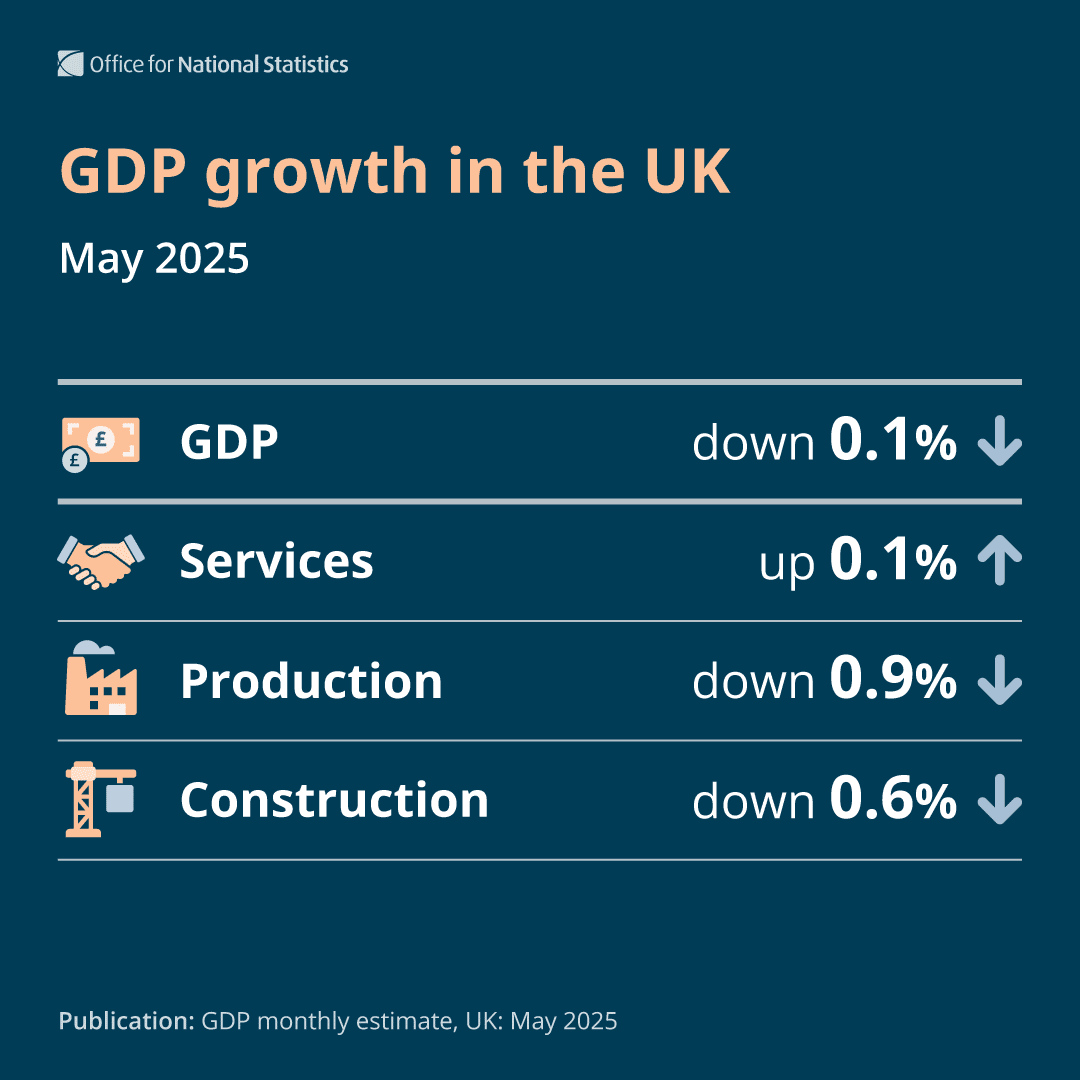
“CATASTROPHIC news for the government” is how one financial expert has defined the estimated 0.1% fall in GDP in May 2025, following an unrevised fall of 0.3% in April 2025, according to official data published this morning. March growth was revised up to 0.4% from 0.2%.

Production was one of the main downward drags in May, with output falling by 0.9%, following an unrevised fall of 0.6% in April 2025. Construction output also fell by 0.6% in May, following growth of 0.8% in April (revised down from 0.9% growth). Monthly services output grew by 0.1% in May 2025, following a fall of 0.3% in April 2025 (revised up from a 0.4% fall).

Liz McKeown, ONS director of economic statistics, said that "the economy contracted slightly in May with notable falls in production and construction only partly offset by growth in services. May’s fall in production was driven by oil and gas extraction, car manufacturing and the often-erratic pharmaceutical industry." She added May was a particularly weak month for retail sales.

Samuel Mather-Holgate, Independent Financial Adviser at Mather and Murray Financial, said “this is catastrophic news for the government”. He added: "The economy is in decline and these figures cement the trend. Starmer and Reeves need to respond to this news, and it needs to be quick. Waiting for the autumn Budget isn’t the pace of change that was sold to their voters."

Sam Kirk, Managing Director at J-Flex Rubber Products commented: "These figures clearly bring new meaning to Labour’s motto of going "further and faster". The trouble is, it's the wrong direction."

Harry Mills, Director at Oku Markets, agreed that "this is terrible news for the Chancellor, whose narrative of the economy "beginning to turn a corner" looks increasingly far-fetched. Growth is stalling, inflation is rising, confidence is evaporating, and wealth-creators are being forced to leave. When will this government wake up and realise it's the spending that's the problem?"

Ranald Mitchell, Director at Charwin Mortgages, said the economy is on life support: “Another month, another contraction in UK Plc. Production’s down, construction’s down, and services are on life support. If this is the government’s idea of stability, we’re in trouble. The FTSE may be flying, but the real economy’s stuck in reverse. A much needed rate cut in August now looks more likely, which could be a boost to borrowers and a blow to savers.”

Rohit Kohli, Director at The Mortgage Stop, added:"This morning’s GDP figures confirm what many of us on the ground have been seeing for months: the economy is shrinking. This government has never had a credible plan for growth. Instead, we’ve seen increased costs for businesses and little incentive to invest, hire or innovate. It’s hard to see how that reduces the deficit or supports recovery. If the Government is good at anything, it’s U-turns — and it’s now time for another. For borrowers, all eyes now turn to the Bank of England. These numbers surely guarantee another base rate cut next month."

Colin Low, Managing Director at wealth manager Kingsfleet, commented: "It’s generally accepted that economic policies take 6-9 months to feed into financial data. Consequently, a new Government can be allowed a period of grace as much of the early news in their new parliament is a result of their predecessor.

“However, last week we class the first anniversary of the election of the Labour government with their primary objective of ‘growth’. There can now be no doubt that we are seeing quite the opposite. The early policies adopted have only succeeded in slowing the economy.”

More follows….
10 responses from the Newspage community

Copy all

Star Quote
Copy

We start this morning with the news that UK GDP contracted by 0.1% in May, following a 0.3% fall in April. Analysts were expecting 0.1% growth, so this is a downside surprise, but it's not wholly unexpected for an economy reeling from self-inflicted policy wounds and persistent structural headwinds. Declines in production output were a major contributor, with manufacturing down 1% and industrial production down 0.9%. Construction output also fell by 0.6%, with the important services sector only rising by 0.1% following a fall of 0.3% in April. This is terrible news for the Chancellor, whose narrative of the economy "beginning to turn a corner" looks increasingly far-fetched. Growth is stalling, inflation is rising, confidence is evaporating, and wealth-creators are being forced to leave. When will this government wake up and realise it's the spending that's the problem? And the insanely high level of economic inactivity at 21.3%? Oh, and the shocking productivity level?
Copy

Another month, another contraction in UK Plc. Production’s down, construction’s down, and services are on life support. If this is the government’s idea of stability, we’re in trouble. The FTSE may be flying, but the real economy’s stuck in reverse. A much needed rate cut in August now looks more likely, which could be a boost to borrowers and a blow to savers.
Copy

This morning’s GDP figures confirm what many of us on the ground have been seeing for months: the economy is shrinking. This government has never had a credible plan for growth. Instead, we’ve seen increased costs for businesses and little incentive to invest, hire or innovate. It’s hard to see how that reduces the deficit or supports recovery. If the Government is good at anything, it’s U-turns — and it’s now time for another. For borrowers, all eyes now turn to the Bank of England. These numbers surely guarantee another base rate cut next month.
Copy

Although GDP is only slightly worse than expected, this is catastrophic news for the government. The economy is in decline and these figures cement the trend. Starmer and Reeves need to respond to this news, and it needs to be quick. Waiting for the autumn Budget isn’t the pace of change that was sold to their voters.
Copy

With two consecutive months of GDP declines—even if modest—it’s hard not to ask: where’s the growth Labour promised? The data suggests the UK is stuck in neutral—or even reverse. Rachel Reeves needs to find a forward gear and the accelerator pedal, and quickly. Weakness in production and construction hints at stalled investment, while services are flatlining. This stagnation puts pressure on the Bank of England to cut rates in August, which would help borrowers but hit savers, who might want to lock into fixed rates now. Lower rates could support the FTSE.

The country’s in such an economic mess that we need big ideas, real action, and actual growth—not just vague competence. Sadly, Labour seem unable to deliver this.
Copy

This government has targeted growth but the only thing that's growing is the tax rate on business. We seem to be limping aimlessly towards the Autumn budget, when either taxes will need to go up again or spending will need to be constrained.
Copy

Another month of economic contraction reveals the harsh reality: while the government promises to build more houses, construction output has tumbled 0.6%. With nearly half of UK GDP tied to government spending, these figures suggest the economy remains stuck in reverse gear rather than moving "further and faster" as Labour pledged. The numbers paint a concerning picture—production declining, construction stalling, and services barely keeping their head above water. After a year in power with growth as their primary objective, it's becoming clear that increased business costs and reduced investment incentives are achieving quite the opposite effect. The Bank of England may need to step in with rate cuts, but that's hardly the sustainable growth strategy voters were promised.
Copy

These numbers reflect a deeper structural weakness. Despite political promises of growth and stability, we’re seeing evidence of a sluggish, increasingly fragile economy. However, what is arguably more concerning than the headline figures themselves is the questionable reliability of official statistics. GDP, in its current form, is heavily distorted by government borrowing and unfunded spending, which artificially inflates economic activity. When one strips out deficit-funded public sector expansion—particularly in areas like healthcare, civil service pay, and other subsidies—private sector output appears significantly weaker. In reality, the UK economy has likely been stagnating or contracting for much longer than official data suggests. This is already being priced in: gilt yields have surged, and sterling has weakened, reflecting declining investor confidence.
Copy

These figures clearly bring new meaning to Labour’s motto of going "further and faster". The trouble is, it's the wrong direction. It's time for Rachel Reeves to wipe away the tears and start properly leveraging taxes, instead of pretending everything is ok and loading the burden on specific groups.
Copy

It’s generally accepted that economic policies take 6-9 months to feed into financial data. Consequently, a new Government can be allowed a period of grace as much of the early news in their new parliament is a result of their predecessor. However, last week we class the first anniversary of the election of the Labour government with their primary objective of ‘growth’. There can now be no doubt that we are seeing quite the opposite. The early policies adopted have only succeeded in slowing the economy.