
Copy article

OECD says GDP growth expected to slow down in UK in 2026

ended 02. December 2025

THE growth of the UK economy is set to slow over the next two years, according to new research.

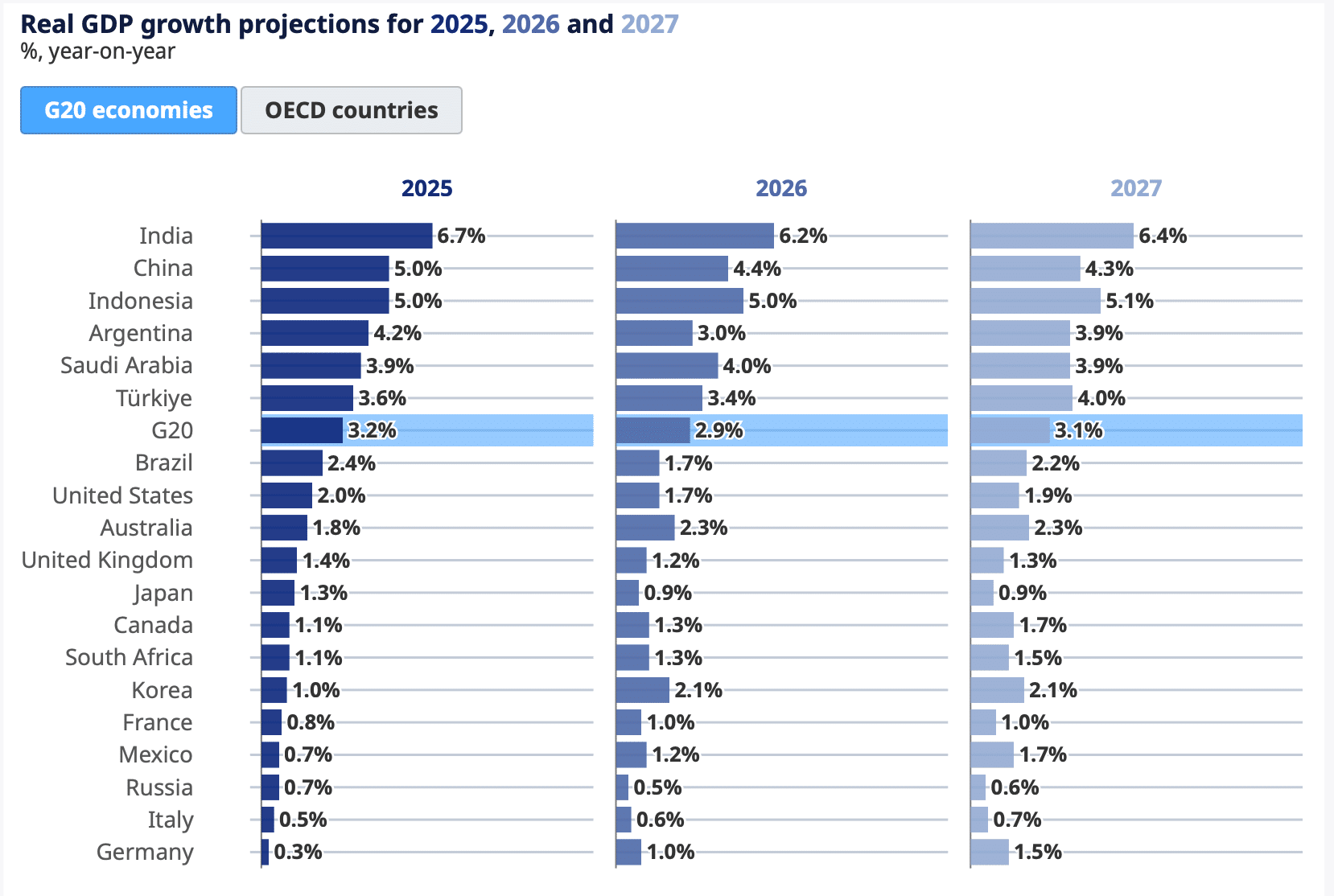
GDP growth in the UK is projected to ease to 1.2% in 2026, “due to the continued effect of budgetary tightening on consumption and to the drag from global uncertainty”, before edging up to 1.3% in 2027, the Organisation for Economic Co-operation and Development (OECD) says in new research.

It predicts that headline inflation will remain elevated at 2.5% in 2026 and easing to 2.1% in 2027, though staying above target over the entire period. The unemployment rate projected to reach 5% in 2027.



4 responses from the Newspage community

Copy all

Copy

This should be a warning to the chancellor that her tax plans have gone too far. The government have long relied on being able to say that the UK is the fastest growing economy in the G7 and these easing forecasts put that claim at risk. 1.4% is pretty paltry and so to see that decline is not the sign of a healthy economy.
Copy

The idea that the UK job market sails smoothly into 2027 with a mere 5% unemployment rate is dangerously optimistic, suggesting the OECD hasn't grasped the speed of the AI bulldozer that the boardrooms have.

When GDP is projected to crawl at 1.2% in 2026 and inflation is still biting at 2.5%, businesses are facing a doom spiral with their margins. They aren't going to absorb rising operating costs and higher minimum wages out of goodwill. They will automate the easily replaceable roles: that’s survival, not strategy. Low-grade white-collar work is ripe for this cull.

The 5% prediction relies on two things that are far from guaranteed: stable global conditions and continued domestic consumption. Any shift in that fragile stability, a deeper global slump or consumers finally collapsing under the weight of 'budgetary tightening', will send joblessness surging past that figure. The official forecast is a floor, not a ceiling.
Copy

The OECD’s forecast tells us UK PLC isn’t heading for a boom or a bust. We’re settling into something far worse. A long, slow shrug of resignation. One per cent growth is an economy sleepwalking with its shoelaces tied together. Households are told to “keep calm” and small businesses are expected to perform miracles on shrinking margins whilst the forecast predicts more of the same. Cloudy with a chance of taxes. Consumers will take the hit because they are always the shock absorber of last resort. Every policy “tightening”, every cost increase, every ounce of global uncertainty rolls downhill until it reaches the kitchen table. This is the bill arriving for years of underpowered policy and overpromised stability.
Copy

Celebrating 1.2% growth while inflation eats away at wages is like patting yourself on the back for treading water in a storm. The OECD’s forecast exposes a fundamental flaw in our current economic thinking: you cannot cut your way to prosperity.
Budgetary tightening might make the balance sheets look tidy for economists, but it strangles the real economy. For small businesses, this is a pincer movement. Customers have less disposable income and inflation keeps running costs painfully high. When consumption is deflated, SMEs stop taking risks and stop hiring.
My concern is stagnation will drive businesses toward bad automation, using AI purely to slash headcount rather than improve service. That is short-term thinking for a long-term problem. The consumer bears the brunt every time: higher prices, worse service, and a predicted rise in unemployment to 5%.
We need to stop looking at 'middle of road' GDP figures as a success and start worrying about people and businesses paving that road