
Copy article

Nearly 80% of Brits would trust AI with their data

ended 24. March 2026

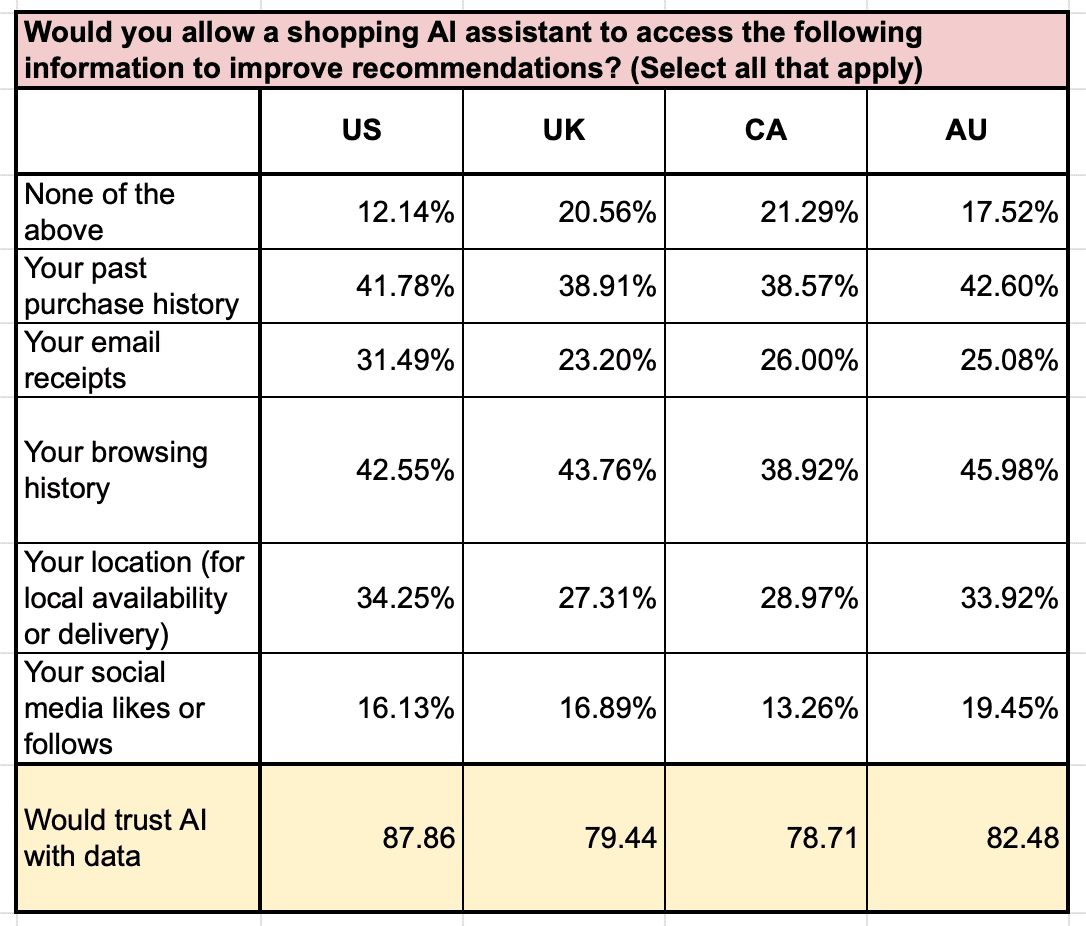
An Omnisend survey shows nearly 80% of Brits would trust AI with their data.

Nearly 44% would let AI access their browsing history (full details of what else Brits would allow AI to access below in the table).

  • How dangerous is it to give AI access to all your data?
  • Are you surprised Brits are so happy to give their data over freely to AI?
  • What advice would you give to Brits while using AI?

Responses by tomorrow.
5 responses from the Newspage community

Copy all

Copy

This ignores critical security lessons from the recent wave of global breaches.

If IT departments are already struggling to secure legacy infrastructure, the unmitigated rollout of AI compounds that risk exponentially.

AI is not "Alien Intelligence", it is software running on third-party hardware, which significantly expands your attack surface.

Every new deployment introduces fresh vulnerabilities, from prompt injection to hidden backdoors, many of which are occurring so frequently they no longer even make the headlines.
Strategic Risks include Compounded Complexity:

Layering AI over already vulnerable legacy systems creates a "security debt" that is difficult to repay.

Third-Party Exposure, where outsourced hardware creates systemic loops and data leakage risks.

Not to mention Novel Vectors, Prompt hacking and logic loopholes are no longer theoretical, they are active threats.
Copy

80% of Brits backing AI is a data-fatigue dilemma, where worn-out workers wave through risks for a whiff of convenience. This isn’t blind trust, it’s burnout — after years of scandals from Cambridge Analytica to endless cookie pop-ups, people feel the privacy battle is already lost. Handing over browsing history isn’t seen as dangerous, it’s seen as pointless to resist when every platform already has a piece of you. That exhaustion is exactly what AI firms are banking on, turning tired clicks into a steady stream of deeply personal data. Unless protections catch up, Britain won’t just be using AI — it’ll be sleepwalking into surrendering its digital selves.
Copy

With the advent of AI, we are ceding power to its greater intelligence and speed of operation. It can be seductive to input a prompt or two and output information or work that would ordinarily have taken you several hours to produce yourself. This engenders de facto trust in the tools being used, without a second thought for data security and ethics.

It’s not so long ago that Mark Zuckerberg was in front of the Senate answering to days of questioning about data misuse by Meta. Facebook and Instagram have been operating for years without ever having been held to account before, and so it should not come as any surprise to think that AI tools could be collecting your information for nefarious means too. Our human interactions are teaching these tools, which means the data we are feeding in, and the debates and qualifying questioning we pose to chat agents is most definitely being used to train the agents. Protect your own privacy, because software houses aren’t going to do it for you!
Copy

I’m not surprised, but I am worried. We’ve spent a decade training people that “free” digital services cost data, so handing the same data to an AI assistant feels normal. The danger is that AI makes that data far more usable and far more portable. A browser history is not just “sites you visited”, it is your habits, triggers, health hints, politics, finances, and who you are when nobody’s watching.

The practical risk is not a Terminator scenario. It is mundane: data being retained longer than you expect, reused to train models, stitched together across tools, or exposed in a breach. Once it’s out, you cannot take it back.

My advice is simple. Assume anything you paste into an AI could become public. Do not share passports, bank details, medical information, or client data. Use the minimum access that still gets the job done, turn off history where you can, and use paid or workplace accounts with clear data handling terms. Convenience is not consent.
Copy

Brits aren't naive, they're realists. They've lived inside social media surveillance for twenty years and this is the first time sharing data has offered them something tangible back.

Cookie tracking never saved anyone time. AI assistants, however, promise less grunt work and less wading through churned content noise. Compared to what people have already given away for nothing, the trade feels rational. Because it is.

But here's what's changed. The AI race started with hyperscalers and governments. Now it's reaching consumers. Share more data, get sharper tools. Don't, get the generic version. Fall behind. We've seen this with loyalty cards and app permissions, except the gap between participants and holdouts is about to get wider, faster.

That's not a privacy failure. It's an economic ratchet. People clicking "yes" aren't confused. They've done the maths. The question is why nobody's building a version where privacy, speed and functionality aren't a forced trade off.