
Copy article

'All eyes are on Threadneedle Street' as Nationwide increases fixed rates up to 0.15%

Journalist: Justin Moy, Contributing Editor

ended 28. January 2025

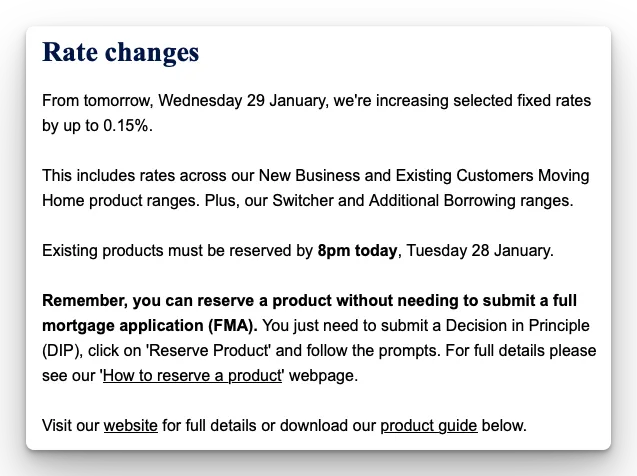
Nationwide is the last main high street lender to increase rates, up to 0.15% on selected fixed deals. With the entire high street now re-priced higher than at the beginning of January, we asked brokers is this where we are going to see rates for a while, or will February see any type of recovery. They also gave their thoughts on whether the end of the current Stamp Duty incentives are causing a slowdown in new lending.

Newspage asked brokers for their opinions and thoughts on the announced changes, which are due to go live on January 29th.
 

5 responses from the Newspage community

Copy all

Star Quote
Copy

The highly anticipated rate war at the start of the year simply didn’t happen. Chaos in the markets in the first half of January has caused rates to go up and Nationwide has also now repriced in the wrong direction for borrowers. Activity levels haven’t dropped off a cliff but we had hoped for a more buoyant start to 2025. All eyes are on Threadneedle Street. The weakness of the economy may result in rate cuts that will potentially provide the property market with the stimulus it needs.
Copy

It is a shame to see more mortgage rate increases, but Nationwide are the last to react to the rise in Swap prices over the last few weeks. With no sign of improvement soon, we can only hope a natural lull once the Stamp Duty incentive cases are completed at the end of March will force the cost of funds down, and some improved rates, but until then it's hard to get enthused by the current market conditions.
Copy

All the major lenders have now repriced their products upwards, which will be disappointing news for the millions of homeowners whose current deals are set to end this year and for those in the market to buy. Unfortunately, given the current political and economic uncertainty, it’s unlikely we’ll see a sudden drop in rates anytime soon. That said, everything hinges on February’s inflation figures. If inflation continues to ease and business confidence remains subdued, the Bank of England could find itself under growing pressure to cut the base rate. Such a move would help to support the housing market and provide some much-needed relief for borrowers. However, the end of the Stamp Duty incentives could add further challenges, potentially leading to a slowdown in new lending as buyers reconsider their options in this higher-rate environment.
Copy

The much-anticipated January mortgage rate war has fizzled into a damp squib, with Nationwide becoming the final high street lender to march rates upward by 0.15%. Rather than the New Year bringing cheer for borrowers, we've watched the entire mortgage market shift in precisely the wrong direction.
The economic tea leaves aren't offering much comfort either, with swap rates remaining stubbornly high and the Bank of England showing little appetite for rate cuts. While we might hope for some respite when the stamp duty deadline passes in March, forcing a natural market cooldown, it's difficult to see any immediate silver linings. The property market seems caught in a perfect storm of rising rates, uncertain inflation figures, and the looming end of stamp duty incentives – leaving both lenders and borrowers watching Threadneedle Street with bated breath.
Copy

The small increase in rates from Nationwide are a result of increases in SWAPs over the duration of January. SWAP rates have settled recently, so i would not expect rates to increase with other lenders. Nationwide's decision to increase is likely to be a result of being competitive in the market and wanting to cool the amount of business being received.