Copy article

6 responses from the Newspage communityCopy all
Copy all
Copy

Mark AlexanderVerified
Founder at Property118.com
iContact details are shown to logged-in members. Log in
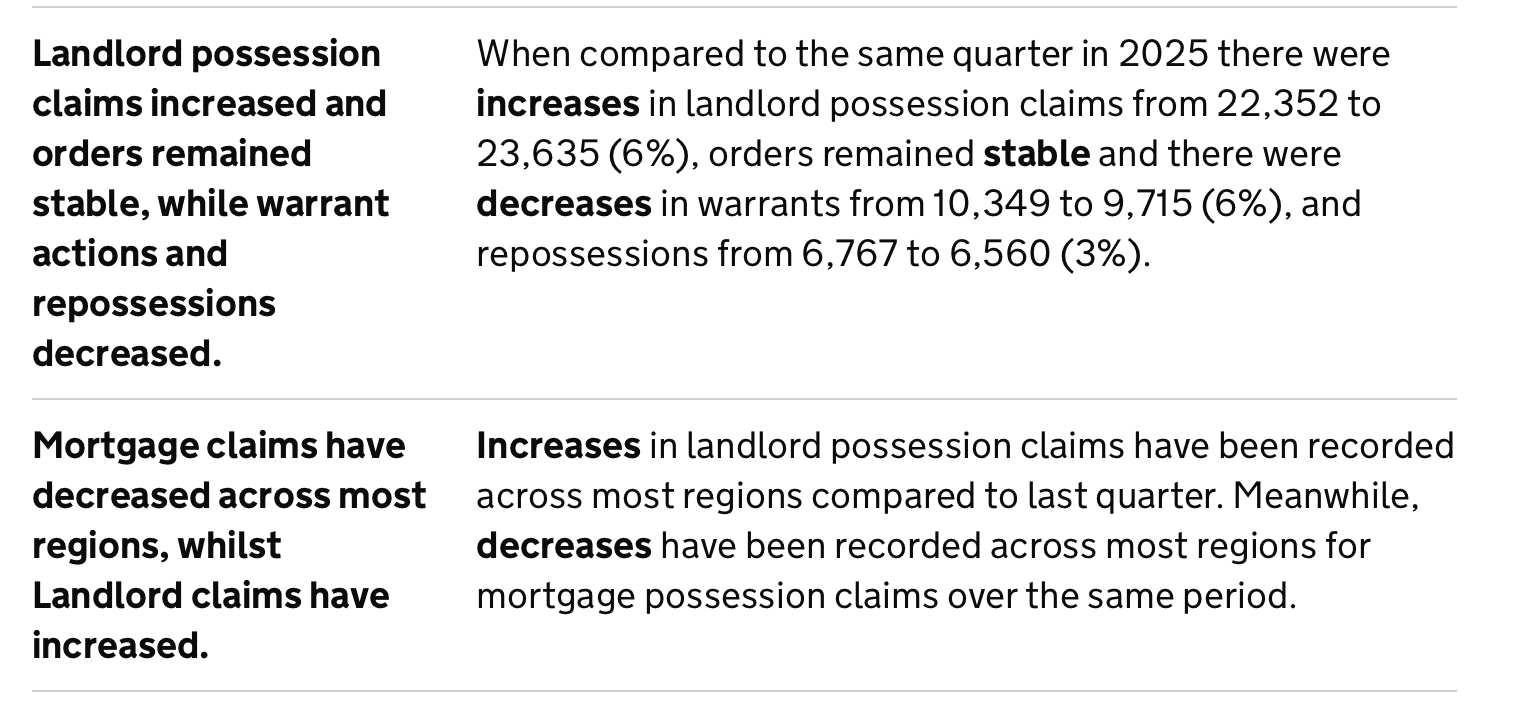
These figures must be read together, but not conflated. Across the UK, buy-to-let mortgage arrears fell 26% year-on-year and lender possessions fell 20%. In England and Wales, however, landlord possession claims against tenants rose 6%, with accelerated claims up 16%. That does not support a narrative of landlords being forced out by their banks. It suggests more owners are deciding, or finding it necessary, to recover possession even while mortgage distress across the sector is falling.
The timing also matters. This quarter included the final month before the Renters’ Rights Act took effect and the first two months afterwards, so the sharp rise in accelerated claims warrants close scrutiny. Policymakers should remember that tenant security depends not only on stronger rights, but also on retaining enough responsible landlords and homes to rent. If letting becomes commercially unattractive or unnecessarily risky, viable landlords will leave.
The timing also matters. This quarter included the final month before the Renters’ Rights Act took effect and the first two months afterwards, so the sharp rise in accelerated claims warrants close scrutiny. Policymakers should remember that tenant security depends not only on stronger rights, but also on retaining enough responsible landlords and homes to rent. If letting becomes commercially unattractive or unnecessarily risky, viable landlords will leave.
Copy

Tony SanchezVerified
Founder at Bridging Loan Directory
iContact details are shown to logged-in members. Log in
The two releases point in the same direction. UK Finance recorded fewer homeowner and buy-to-let mortgages in arrears, while Ministry of Justice figures show mortgage possession claims, orders, warrants and repossessions all falling compared with last year.
They measure different parts of the process and should not be treated as interchangeable, but together they suggest mortgage distress is easing rather than simply being delayed between stages.
There is still a substantial lag. The median time from a mortgage claim to repossession has increased to 49.1 weeks, so completed cases can reflect financial difficulties that began almost a year earlier.
The contrasting figure is landlord possession claims, which rose by 6% even as warrants and repossessions fell. That does not yet establish the effect of recent rental regulation, but it is a separate pressure worth monitoring.
They measure different parts of the process and should not be treated as interchangeable, but together they suggest mortgage distress is easing rather than simply being delayed between stages.
There is still a substantial lag. The median time from a mortgage claim to repossession has increased to 49.1 weeks, so completed cases can reflect financial difficulties that began almost a year earlier.
The contrasting figure is landlord possession claims, which rose by 6% even as warrants and repossessions fell. That does not yet establish the effect of recent rental regulation, but it is a separate pressure worth monitoring.
Copy

Darryl DhofferVerified
Founder at The Mortgage Geezer
iContact details are shown to logged-in members. Log in
The latest Q2 2026 data brings some genuine relief. Homeowner mortgages in arrears fell 1% to 77,940, while buy-to-let arrears dropped 6% to 8,390. Reassuringly, repossessions also plummeted, down 8% for homeowners (1,150) and 22% for landlords (630).
As a bad credit mortgage specialist, I see this every day where falling behind on your mortgage payments doesn't mean giving up your home. With arrears representing just 0.89% of all mortgages, the market is showing resilience. If you're struggling, specialised options exist to help restructure your debt early and keep you in control.
As a bad credit mortgage specialist, I see this every day where falling behind on your mortgage payments doesn't mean giving up your home. With arrears representing just 0.89% of all mortgages, the market is showing resilience. If you're struggling, specialised options exist to help restructure your debt early and keep you in control.
Copy

Nouran MoustafaVerified
Practice Principal & IFA at Roxton Wealth
iContact details are shown to logged-in members. Log in
These numbers are more reassuring than alarming. UK Finance shows homeowner arrears down 1% quarter-on-quarter and buy-to-let arrears down 6%, while possessions fell 8% and 22%. MoJ data shows mortgage claims down 20% year-on-year and repossessions down 14%. That tells me pressure is easing rather than building into a new repossession crisis.
The one number I would not ignore is 49.1 weeks from claim to repossession, up from 42.9 weeks. Repossessions are therefore a very lagging indicator: some households losing homes today may have fallen into trouble nearly a year ago, when rates and affordability looked very different. So today's falling arrears matter more for where we're heading. The data suggests the worst of the mortgage shock is moving behind us, but the clean-up is still working through the system.
The one number I would not ignore is 49.1 weeks from claim to repossession, up from 42.9 weeks. Repossessions are therefore a very lagging indicator: some households losing homes today may have fallen into trouble nearly a year ago, when rates and affordability looked very different. So today's falling arrears matter more for where we're heading. The data suggests the worst of the mortgage shock is moving behind us, but the clean-up is still working through the system.
Copy

Stephen PerkinsVerified
Norwich Mortgage Broker and Managing Director at Yellow Brick Mortgages
iContact details are shown to logged-in members. Log in
The overall direction is encouraging, with fewer mortgages in arrears and possession activity also moving the right way. But falling arrears don’t necessarily mean every borrower has recovered financially. Some will have caught up, while others may have sold or ultimately lost their property, so the figures need to be viewed together.
The contrast with the rental sector is interesting. Buy-to-let mortgage arrears and possessions are falling, yet landlord possession claims have increased. That suggests the pressures facing landlords and tenants extend beyond landlords simply struggling to pay their own mortgages.
The contrast with the rental sector is interesting. Buy-to-let mortgage arrears and possessions are falling, yet landlord possession claims have increased. That suggests the pressures facing landlords and tenants extend beyond landlords simply struggling to pay their own mortgages.
Copy

Jamie AlexanderVerified
Mortgage Director at Alexander Southwell Mortgages
iContact details are shown to logged-in members. Log in
The headline is more reassuring than alarming. Homeowner arrears down, buy-to-let arrears down, possessions falling across the board. For a period that followed one of the sharpest rate cycles in recent memory, that is genuinely encouraging.
The number worth sitting with is the 49.1 week median time from claim to repossession. That lag means completed cases today often reflect difficulties that started almost a year ago, when the rate environment looked very different. So falling arrears now matter more than the repossession figures as a guide to where the market is heading.
The one watch point is landlord possession claims against tenants, which rose 6% even as mortgage distress in the sector fell. That tells a different story.
Overall the data suggests the worst of the mortgage shock is moving behind us. It is not clean yet, but the direction is right.
The number worth sitting with is the 49.1 week median time from claim to repossession. That lag means completed cases today often reflect difficulties that started almost a year ago, when the rate environment looked very different. So falling arrears now matter more than the repossession figures as a guide to where the market is heading.
The one watch point is landlord possession claims against tenants, which rose 6% even as mortgage distress in the sector fell. That tells a different story.
Overall the data suggests the worst of the mortgage shock is moving behind us. It is not clean yet, but the direction is right.