
Copy article

Moneyfacts: stocks and shares ISA outperform cash by £100

ended 11. December 2025

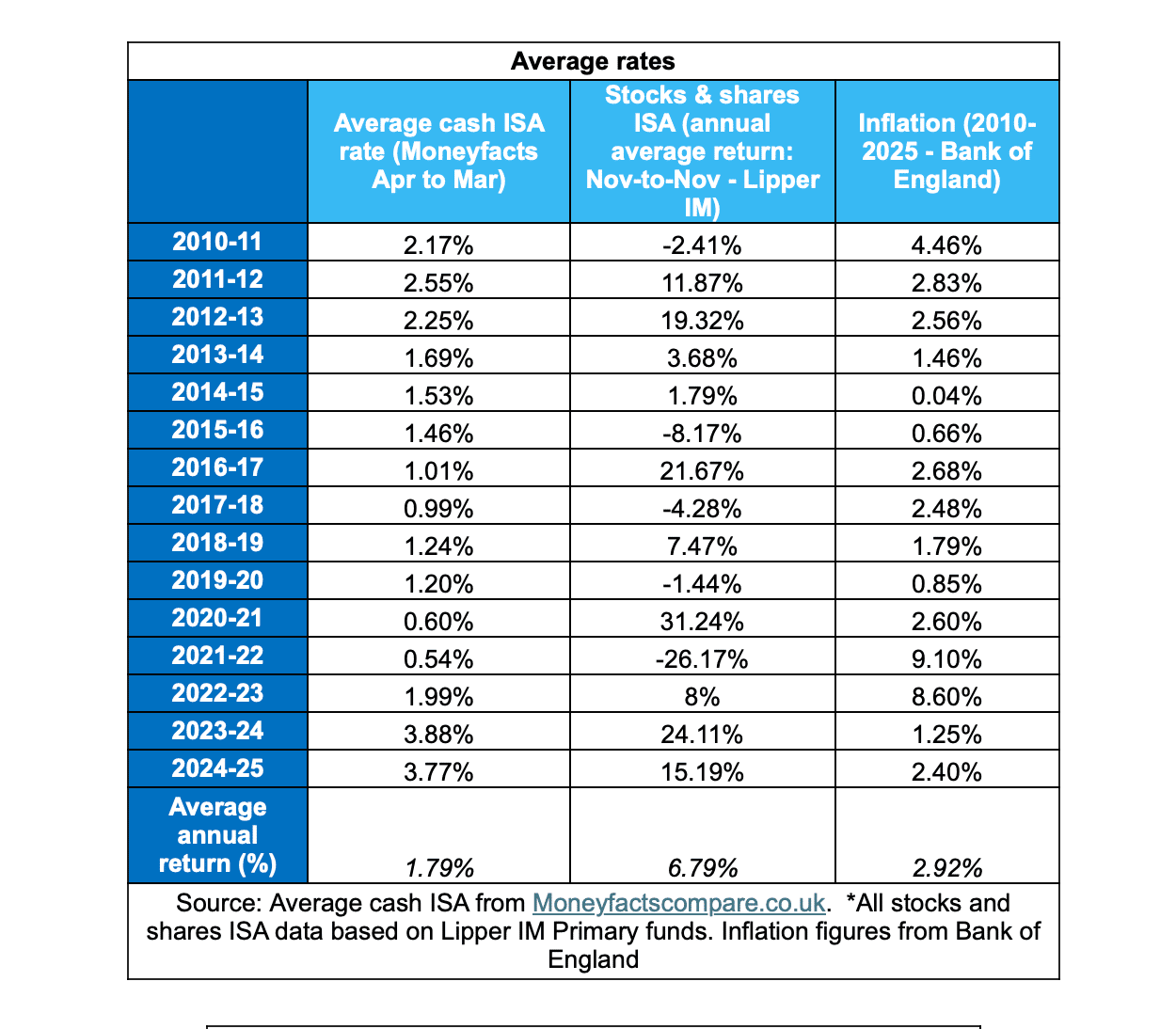
New research from Moneyfactscompare.co.uk published today shows (surprise surprise) that, since 2010, the average cash ISA grew £100 to £130, meanwhile, around the same amount in the typical stocks & shares ISA grew to £233, meaning investors are £103 better off for every £100 invested. The average annual return for a cash ISA is 1.79%, while stocks & shares ISAs at 6.79% easily outpace inflation at 2.92%. Moneyfacts says turbulent returns on stocks & shares ISAs may make them more suited for long-term growth but may damage returns if money doesn’t stay invested for long. Your views ASAP please.

5 responses from the Newspage community

Copy all

Star Quote
Copy

We have been banging on about this for a long time.

The uk has a scrimping and saving mentality.

We need a wealth mentality.

We critiqued Martin Lewis back in November about the years of instilling a scrimping and saving mindset in UK consumers and lo and behold, just a few days ago he has done a show on investing…

https://fink.money/we-finally-convinced-martin-lewis/

The problem with Brits is we confuse risk with volatility. They aren’t the same thing. Bitcoin is volatile but has the best risk adjusted returns of the last 15 years.

The issues we have stem from lack of process behind investing, and as Martin sort of rightly says, this stems from a fear of saying the wrong thing and landing in hot water with regulators.
Copy

This is one of the best kept secrets of finance. Most people I speak to haven't heard of stocks and shares ISAs or instantly think of cash when you say ISAs. For long term savings, where you're looking to build up a pot, ISAs are great. They shield your money from income tax and dividends and you can withdraw whenever you want. You don't have to fill out a self asessement for them and if you get the investments right, growth will follow. Losses can and will happen from time to time, and that's where having time on your side comes in. If you're holding sensible investments, they'll do just fine.
Copy

The starting point has to be why the money is being invested and when it is likely to be needed, rather than which ISA type appears to have “won” over a particular historic period. Time horizon and the purpose of the funds drive the strategic asset allocation; cash vs stocks and shares choice is secondary. For money that may be required in the near term, capital security and ready access are usually more important than chasing higher expected returns. By contrast, over multi-year periods, a diversified portfolio of growth assets has a higher expected real return than cash. It is also important to acknowledge that the most recent year in markets has been highly unusual, with returns driven to a large degree by credit pouring into equities. Such performance is exceptional and should not be used as a basis for planning. Basing decisions on recent strong returns encourages performance-chasing, with clients investing after sharp rises and then disappointed when markets correct.
Copy

Cash ISAs have grown in popularity, boosted by banks eager to attract deposits. But holding too much in cash can come at a cost. Inflation erodes value over time and there's a risk of missing out on stronger long term growth. Think about your short, medium and long-term requirements and if in doubt, seek independent advice.
Copy

Over the longer term, we'd expect investments in company shares to grow more than leaving cash in the bank.

After all, if cash really was king, no businesses would exist and everybody would simply leave money in cash!

There will always be periods of time however, where the returns on cash are higher than what stocks and shares deliver. Sadly, these periods can't be predicted in advance, so it's absolutely the case of accepting periods of negative performance in the pursuit of better returns than cash.

The whole point behind investing rather than saving is to keep the value of your buying power. The gradual rising cost of goods and service (inflation) will eat away at the value of cash left in the bank.