ICO issues guidance to help public sector fulfil rising AI-generated FOI requests
AI can now file Freedom of Information (FOI) requests faster than public bodies can answer them and the funding is staying the same. Where does this leave UK public sector transparency?
The ICO has published guidance to help public authorities handle a surge in AI-generated Freedom of Information requests. The guidance clarifies that existing law still applies and that section 14 refusals can cover AI-driven abuse, specifically vexatious demands, for example where the same request is sent with different wording in a war of resource attrition. The ICO's own guidance notes these AI-drafted requests can arrive "very long, repetitive and contain unrelated comments or misdirected demands." Whatever the requester's intent, this increase in cases lands on a civil service that is already buckling. Cabinet Office statistics published last week show 94,526 FOI requests hit monitored public bodies in 2025, up 14% on the year before and the highest since records began in 2005.
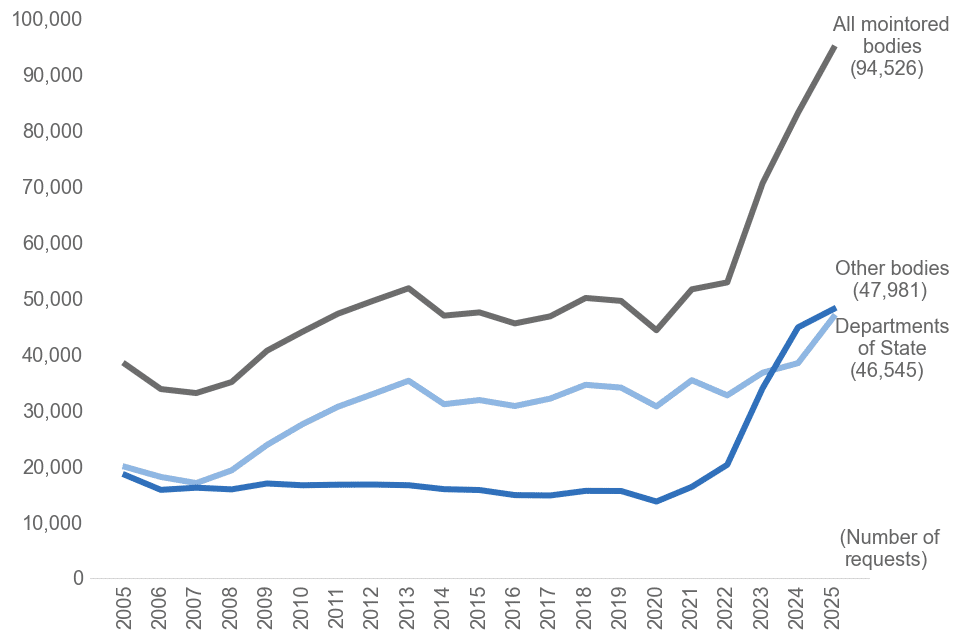
UCL research, cited by Merton Council, puts the average processing cost at £187.50 per request. The ICO compliance review of 26 North West borough councils found almost 1 in 5 responses already miss the 20-working-day statutory deadline.
The Campaign for Freedom of Information reported the Home Office saw the largest increase in volume (+2,382 requests), followed by the Department for Work and Pensions (+1,118). Both departments are responsible for highly contentious portfolios, where an increase in request volumes might be expected.
Despite the uptick in demand, overall timeliness across all monitored bodies improved from 76% to 87%. That headline number deserves a caveat. Much of the improvement was driven by The National Archives. It cleared a backlog caused by a 321% increase in requests following the transfer of 9.7 million MoD records, mainly personnel, part of a six year transfer that began in 2021.
Departments of State themselves stayed flat at 89% both years. The "other monitored bodies" category jumped from 64% to 84%, largely because of that National Archives recovery, not because the system as a whole found new capacity or increased productivity.
The Cabinet Office's outcomes data tells a more complicated story. Of resolvable requests in 2025,
- 36% were granted in full (up from 29% in 2024)
- 35% were withheld in full (up from 30%)
- 21% were partially withheld (up from 15%).
Both grants and withholdings rose because the "not yet processed" backlog shrank, meaning more requests got a definitive answer either way, rather than sitting in a queue.
Of the 34,807 requests withheld in full or in part, 26.6% were refused on cost grounds under section 12, and 2.7% were refused as vexatious or repeated under section 14.
We'd like your views:
- If AI tools can generate FOI requests in seconds but each one costs a public authority an estimated £187.50 and up to 7.5 hours of staff time to process, should the cost limit and hourly rate, unchanged since 2004, be reviewed?
- The ICO says authorities can refuse requests under section 14 where AI is used to send repeated or disruptive submissions. In practice, how does a (typically) one-person FOI team distinguish between a coordinated AI campaign and a genuine increase in public interest?
- Should AI tool providers bear any responsibility for the downstream administrative cost when their products generate FOI requests that misquote legislation or cite provisions that don't exist?
- FOI exists to hold power to account. If the system becomes so overwhelmed that response times collapse, does AI-assisted access to transparency end up undermining the transparency it was meant to strengthen?