Copy article

Flats v houses

ended 11. June 2026

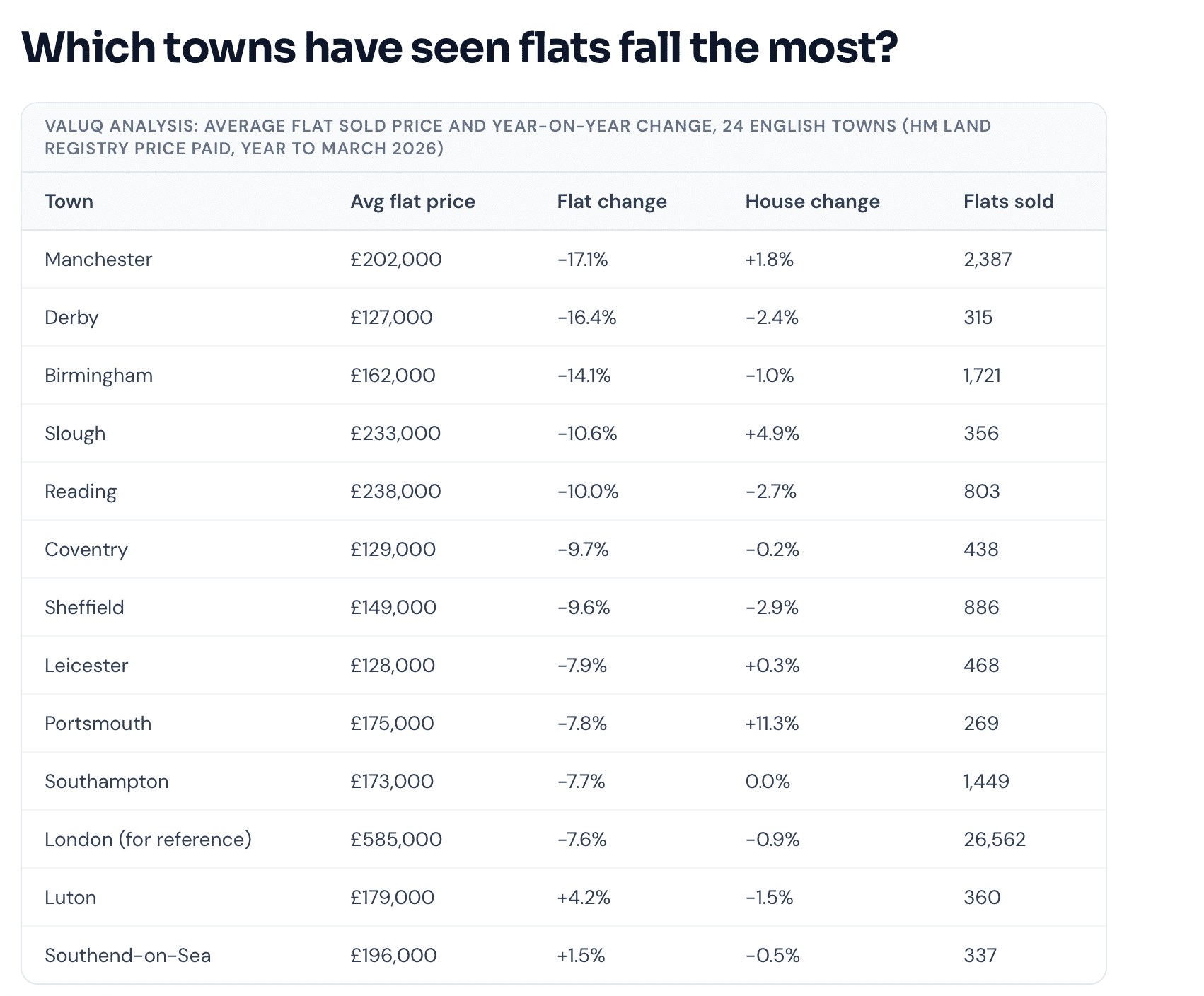
Research from property firm, ValuQ, found that in 22 of 24 English towns it analysed in the year to March 2026, the average flat sold for less than a year earlier, while houses mostly held their value or rose. Key findings below and attached. Why do you think flats are underperforming and does this offer a buying opportunity — or is it a warning to buyers to perhaps steer clear of flats? Any insights, send them across.

  • Ten towns saw flats fall harder than London (down 7.6%): Manchester (down 17.1%), Derby (down 16.4%), Birmingham (down 14.1%), Slough (down 10.6%) and Reading (down 10.0%) led the way.
  • In Portsmouth and Manchester the gap between houses and flats topped 18 percentage points in a single year, a two-speed market inside one town.
  • Two towns bucked it: the average flat rose 4.2% in Luton and 1.5% in Southend-on-Sea.
4 responses from the Newspage community

Copy all

Copy

Flats are less attractive now than ever before due to onerous service charges linked to rising costs and additional regulatory red tape, some of which is a result of the Grenfell disaster. Ground Rent and Management fees are at an all time high and this has to be paid in addition to a mortgage payment. The Leasehold Reform Act received Royal Assent back in May 2024 and none of it has come to pass yet. Reform is needed to make these properties more saleable and to have more appeal as their bad reputation are part of the reason the market is stalling as eager sellers are desperate to move on.
Copy

It's no surprise that First Time Buyers are bypassing the traditional starter-home flats for houses, given the lingering cladding issues and the ever-escalating service charge (and ground rent) problems. When you then add the cost of moving, stamp duty in particular, all of these factors encourage the purchase of houses that will be home for a significant timescale. It will require significant government intervention to accelerate the replacement of flammable materials and regulate service charges; until then, this trend will continue to grow.
Copy

Flats are underperforming because buyers are becoming much more selective. It is not just about the front door anymore; it is service charges, ground rent, cladding history, lease length, management quality, lender appetite and whether the flat still feels affordable once all monthly costs are included.

Houses have held up better because they offer more control: no service charge shock, no lease complications and usually more space. In a higher-rate market, buyers are asking harder questions, and flats with weak fundamentals are being punished.

This can be a buying opportunity, but only for disciplined buyers. A discounted flat is not automatically a bargain if the service charge is rising, the lease is short or the building has unresolved issues.

My view is simple: do not avoid flats blindly, but do not buy one lazily. The right flat, in the right building, at the right price, can still work. The wrong flat can become very hard to sell.
Copy

Flats were once the favoured types of properties for first time buyers and investors. But the race for space in 2020, and Government policies deterring new investors into the market, flats are now out of favour. This is a good buying opportunity for the right flat in the right location which has always been key