
Services PMI sharpens case for September rate cut
The Monetary Policy Committee (MPC) may have started its rate-cutting cycle last week. However, the pace of cuts moving forward will be heavily dependent on one key macroeconomic piece of data — services inflation, as the metric now makes approximately 50% of the inflation basket.
Swap rates have been trading as if September's rate cut is pretty much guaranteed, but any hints that services inflation isn't cooling as quickly as projected could see yields push back up.
In both May and June, the services Consumer Price Index (CPI) came in much higher than the Bank of England (BoE) had initially estimated, at 5.7% vs 5.3%, and 5.7% vs 5.1%, respectively. As a result, the Bank revised its forecasts for services CPI for the rest of the year in its latest Monetary Policy Report. Thus, it was no surprise to see the MPC's decision to cut rates only separated by one vote.
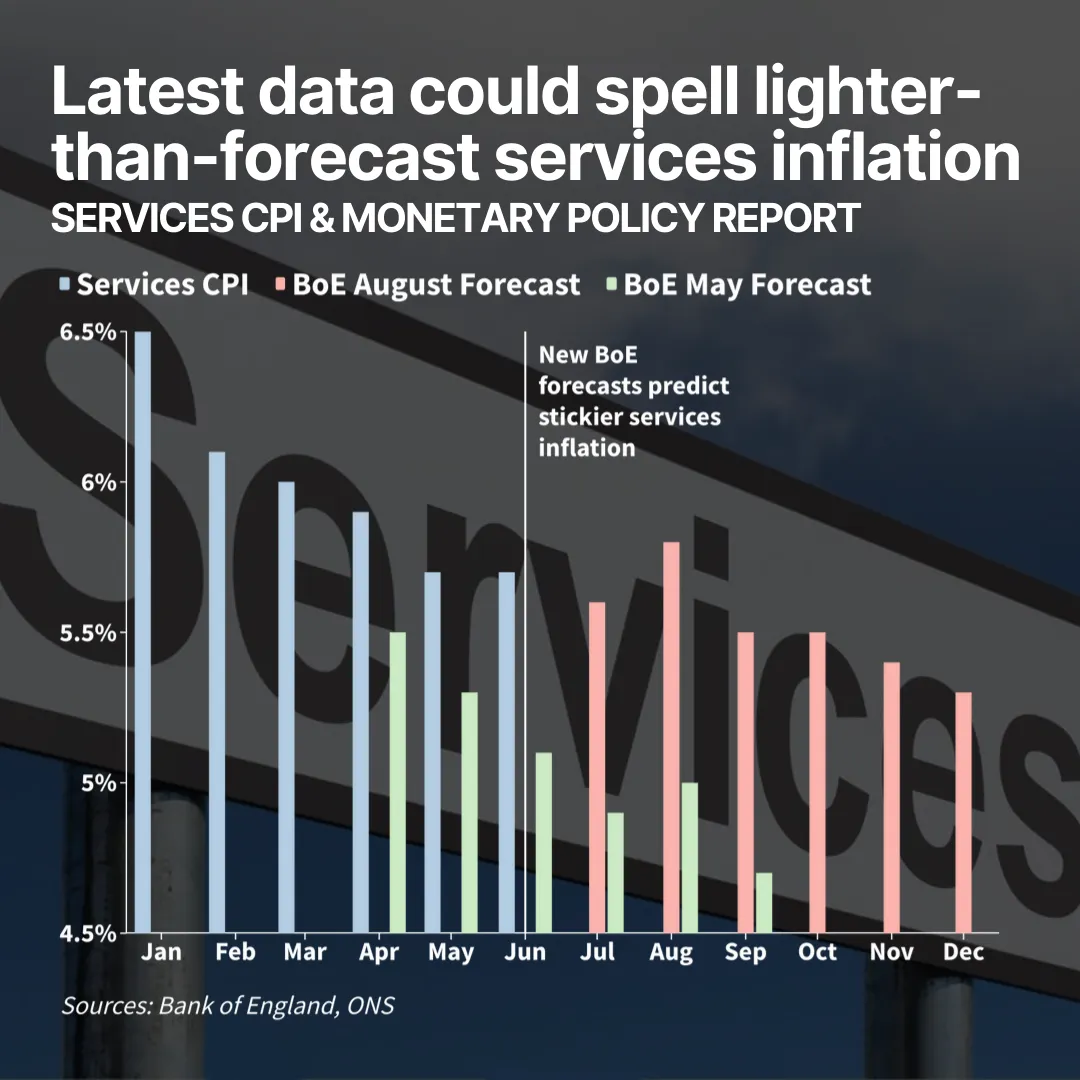
Bank staff also upgraded their projections for headline inflation by an additional 0.1%. CPI is now only expected to peak at 2.7% later this year or early next year, hence Governor Andrew Bailey's more hawkish commentary during his press conference last week. The Governor stated that committee members weren't looking to cut rates too heavily or quickly due to services inflation being so sticky.
With July's inflation data due in less than 10 days' time, this will be a key metric to pay attention to. The central bank only sees services inflation dropping by a mere 0.1% to 5.6%. But the latest services PMI data suggest that there's a possibility that the services print could come in lower than what the BoE forecasted. According to the PMI report, services firms reported that both input and output price inflation fell to their lowest point since early 2021.
Considering the fact that these two PMI metrics have had a flawless success rate in predicting month-on-month (M/M) services inflation so far this year (with the exception of April due to annual one-time effects), the likelihood that services inflation comes in higher than 5.7% seems very unlikely. Therefore, this should bode well for the rate-cut outlook and the property market. This is especially when PAYE pay estimates showed that M/M wages declined, while the latest BoE Decision Marker Panel saw firms raising prices by 4.2% in July, down from 4.6% in May, and the lowest since September 2021.
As the bar for services inflation has been set relatively low, this gives more room for the data to undershoot the Bank's forecast in 10 days' time. Given that the odds of a September rate cut sat at 55% as of Friday, this morning's data should tip the odds more in favour of another cut next month, especially on the back of a market sell off that now sees a 60% chance that the US Federal Reserve could instigate an emergency rate cut before its next meeting in over 40 days' time.
Ultimately, however, the proof will be in the pudding(s), with two inflation releases before the MPC reconvenes in mid-September. But judging by the trajectory of wage growth, the low bar for success, as well as the dovish tilt of the MPC going into its next meeting, there's certainly room for optimism for rate cuts and the mortgage market.