Broadband or Starlink: which is better for UK homes?
By Gabriel McKeown, Head of Research, Newspage · · Updated
Is broadband or Starlink better for UK homes? Full fibre broadband is faster and usually cheaper wherever it is available.
However, Starlink makes most sense for homes that can't get a decent fixed-line connection, especially those in rural areas.
Experts told Newspage that Starlink is poor value for most households. But they conceded that it is “a brilliant solution to a coverage problem”.
They say full fibre broadband is "the better everyday solution when you have the choice".
Starlink's satellite broadband is now an option for UK households alongside full fibre, cable and 4G or 5G home broadband.
Full fibre is currently available to 86% of UK premises according to thinkbroadband's latest coverage figures. However, Ofcom data shows 335,150 premises can't get a decent connection of at least 10Mbps from a fixed line.
London-based broadband provider, Community Fibre, said full fibre gives faster uploads and lower latency. It also copes better when several people are online at once.
It added that Starlink can add hundreds of pounds in kit and installation costs.
Is Starlink better than broadband?
For most people in most homes, no. Mark Jackson, Editor-in-Chief of ISPreview, said: "Most people in the UK will already have access to faster and more capable full fibre broadband packages.
"These will often have cheaper tiers that beat Starlink for speeds and latency.
“But in remote rural areas where full fibre has yet to reach, or some niche urban locations in the same boat, it's a very useful alternative.”
Starlink caps downloads on its Residential 100 Mbps and 200 Mbps plans at those speeds. Its Residential Max plan gets the fastest available speeds and top network priority.
Peter Rampling, Chief Commercial Officer at London-based Community Fibre, said: "Starlink is a useful option where good, fixed broadband simply isn't available. This is particularly the case with rural or hard-to-reach homes. But where 100% full fibre is available, the best option is to choose fibre.
"For a like-for-like comparison, Starlink's standard UK Residential 100 Mbps and 200 Mbps products cap downloads at 100 Mbps and 200 Mbps and only provide upload speeds of 15 to 35 Mbps.
"Starlink's Residential Max delivers service between 80 and 400 Mbps, also with upload speeds of only 15 to 35 Mbps.
"Community Fibre's 1 Gbps Full Fibre provides symmetrical 1,000 Mbps download and 1,000 Mbps upload speed. That upload speed matters for video calls, cloud backup, sharing large files and homes with several heavy users at once."
He added: "So our most popular 1 Gbps service is always much faster than the fastest Starlink service on download and way faster on upload.
"Increasing demand in the future is also future-proofed as we already offer multigig speeds up to 8.5 Gbps."
Is Starlink cheaper than broadband?
For most UK homes, no. Full fibre is faster on uploads, has lower latency and usually costs less each month. Starlink is better only where a decent fixed-line connection isn’t available.
Jackson says: “A lot of the time these days you can access a 100-200Mbps package for the £20 to £30 price point via full fibre, sometimes even less.” That is cheaper than most Starlink plans.
That said, Starlink currently has a 30% discount, reducing its Residential plans to £28, £42 and £56 a month in select areas.
But Rampling added that, on the whole, Starlink is "considerably more expensive for households where competitively priced full fibre is available".
For example, Community Fibre's 1 Gbps Full Fibre package is currently £21/month on a 24-month contract. For that, it delivers symmetrical 1 Gbps download and upload speeds.
The hardware and standard installation are also included with no upfront charge.
That compares with Starlink's standard pricing of £40/month for 100 Mbps, £60/month for 200 Mbps and £80/month for Residential Max.
Rampling said: "Starlink's standard kit starts at around £299 in areas where free hardware is not offered, plus a £19 shipping charge.
"It is designed for DIY installation; if professional installation is required, published UK installer prices start at around £145. This can rise depending on mounting, roof access and cabling requirements.
“In other words, our most popular 1 Gbps service has five times the download speed of Starlink's 200 Mbps product for £39 less per month. The hardware and standard installation is included rather than potentially adding hundreds of pounds upfront.”
Who is Starlink best for?
National Broadband specialises in installing 4G and 5G broadband services, particularly for rural properties where traditional broadband options are limited.
Starlink is a competitor in the rural broadband market, but Robin Carver, the company's Head of Operations, still speaks highly of it.
He said: "Starlink is an excellent solution for rural households with limited broadband options. However, where full fibre (FTTP) is available, we'd generally recommend that over Starlink or mobile broadband.
“For properties without fibre, both Starlink and professionally installed 4G/5G broadband can provide excellent alternatives.”
Carver says Starlink, like 4G and 5G broadband, is fast enough for most people: "Rural broadband solutions such as Starlink and 4G or 5G broadband generally offer more than enough speed for streaming, video calls and everyday internet use.
“Online gaming requires low latency, which both technologies can also deliver, although performance can vary depending on the connection.”
When it comes to cost, Carver says: "One concern is pricing certainty. Starlink's flexible monthly plans mean prices can change, and we've seen significant pricing changes during 2026.
"Customers should be aware that today's price isn't necessarily what they'll pay long term.
"Customer support is also primarily online, which can make speaking directly to someone for assistance more difficult.
“Starlink also requires a clear view of the sky, which can present challenges for some properties.”
Is 4G or 5G broadband an alternative to Starlink?
Yes, for many rural homes. But like Rampling, Carver believes full fibre is the best and most cost-effective option wherever it’s available.
He continued: "Our recommendation is straightforward: if full fibre is available at your property, choose that over Starlink or mobile broadband.
"It's generally cheaper, more reliable and offers more consistent performance. Starlink and mobile broadband are best suited to properties where full fibre isn't available.
"However, we'd encourage rural households not to overlook 4G and 5G broadband. A common misconception is that poor mobile phone signal means mobile broadband won't work.
“With the right network and a professionally installed external antenna, it's often possible to achieve a much stronger connection than a phone receives indoors.”
What is a fast internet connection?
Ofcom defines decent broadband as a connection with at least 10Mbps download and 1Mbps upload speeds. Homes that can't get it can request a connection under the broadband universal service obligation.
Ofcom's spring 2026 update shows just 4,000 premises now lack affordable decent broadband. That is mainly down to Starlink’s lower-priced satellite plans.
Alex Tofts, Broadband Expert at Cambridge-based Broadband Genie, said Starlink "arrived about 10 years too late for most broadband customers".
He added: "Over 86% of the UK can access full fibre, and most bill payers can get a gigabit-capable deal (over 1Gb or 1,000Mb) for £25 a month or less with no setup fee.
"Starlink's primary target audience is people who can't get full fibre or reliable 4G/5G internet.
"Ofcom says 335,150 premises can't get a 10Mb download speed, or what the government deems a 'decent' connection. Starlink offers 100% UK coverage and download speeds between 100Mb and 400Mb depending on the tariff.
"However, it comes at a cost. Prices start at £40 a month, making it one of the priciest deals on the market and poor value for most households.
"That said, if you're in the roughly 1% of the UK still unable to get a decent fixed-line connection, it's likely your best option."
What is Starlink like to use day to day?
Where a fixed line can’t reach, Starlink does the job, but those who use it say it comes at a price.
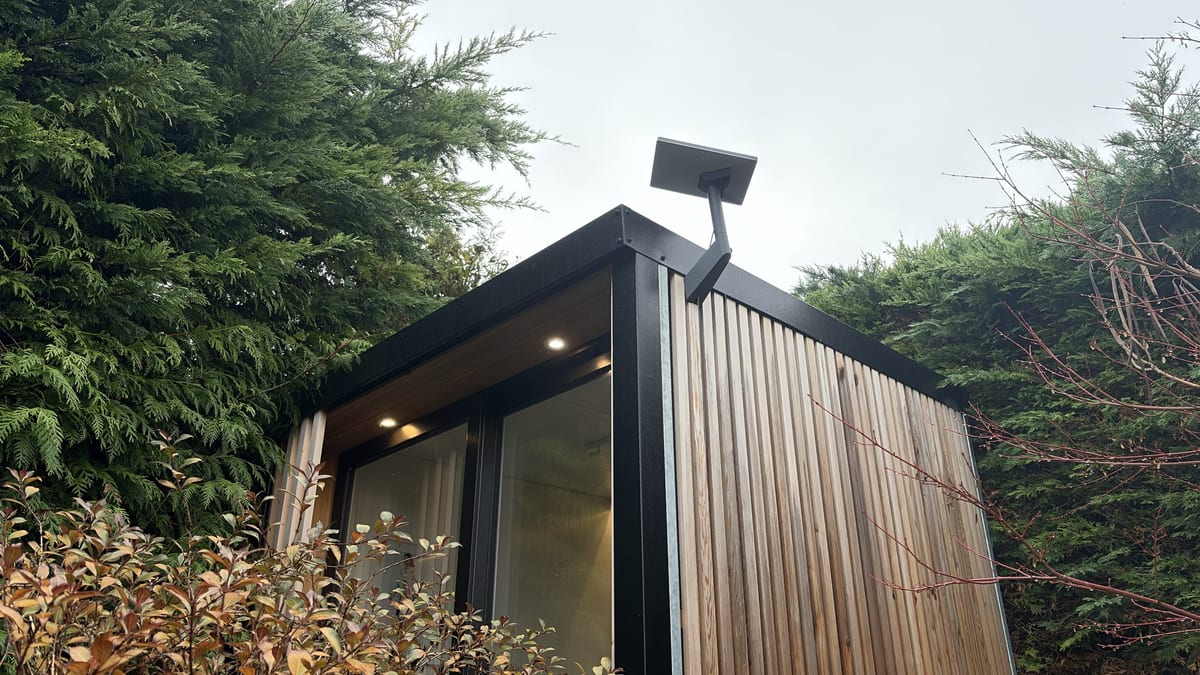
Dominic Hiatt, founder of Newspage, uses Starlink in his garden office in Bath, where the broadband signal from the house is too weak to reach.
He said: “I had a Starlink dish fitted on the roof of my garden office because my broadband won’t reach the end of the garden. Or if it does, it's too unstable to guarantee a connection.
"When I’m working out there it feels just like having broadband, so it’s brilliant for that.
“But it isn’t cheap. I’m on a business plan that costs me £86 a month, which is a lot more than a decent full fibre deal. I'm sure there are cheaper options but I can't afford to be on a Zoom call and then hit a data limit so I pay for more data than I probably need.
"For me, though, it’s worth it because there’s no other way to get a proper connection out there, and that’s really who Starlink is for.
“The setup was easy enough. My friend, an electrician, installed it in under an hour and the dish picks up a really strong signal throughout the day and night.”
Is Starlink fast enough for gaming?
For many gamers, it will be yes. But Jackson says it may not be responsive enough for the serious gamers out there, for whom the quickest pings can mean the difference between a win and a loss.
He said: "There is a catch with online video games as the average latency times on Starlink can be around 20-40ms, while on a full fibre link it's more like 2-6ms.
“This is still fine for most needs, but professional gamers may notice the difference in some situations.”
Starlink says the speeds it advertises are maximum available speeds, are not guaranteed and will be slower during times of congestion.
Is Starlink fast enough for streaming and video calls?
Yes, but possibly not in households where there are lots of people online at once.
Rampling said: "For many single-occupancy homes, Starlink can handle streaming, gaming and video calls. The bigger question is how consistently it performs when several people and multiple devices are online.
"Satellite services usually slow down in the late afternoon and evening, when many other users are typically using the same satellite cell and then the low upload speeds will really suffer. This is unlike a fibre connection, which is not affected in the same way.
"A single-user household is one thing, but in any home the available bandwidth is shared between connected devices.
"The more people and devices using the connection simultaneously, the more speed the household is likely to need as it gets divided up equally."
He added: "Latency is another important consideration, particularly for online gaming and video calls.
"Starlink connections typically have latency of 30ms to 50ms. Community Fibre's full fibre network typically delivers latency of less than 10ms.
"Lower latency means data travels back and forth more quickly, helping provide a more responsive experience for activities such as gaming and video conferencing."
What is the downside to Starlink?
Jackson says Starlink is “notorious for frequently changing pricing and package details for existing customers, often with only minimal notice”.
He added: "The lack of certainty that flows from this uneven behaviour can leave a bad taste in the mouth.
“Some people also experience issues with figuring out where and how to place Starlink's dish due to localised restrictions and access etc.”
Starlink's own installation guidance says each dish should have a clear view of the sky from around 20° above the horizon.
An object such as a tree branch, pole or roof can cause downtime. It suggests a raised installation, such as a pedestal, post or rooftop, to help clear nearby obstructions.
Rampling said: "The trade-off for Starlink's extraordinary reach is that satellite broadband has some limitations that fibre just doesn't have. So, customers should make a careful consideration when thinking about getting a Starlink connection.
"It needs a suitable location and a clear view of the sky. Satellite connectivity is inherently a different proposition from fibre running directly into the home.
"For some flats and high-rise properties, that can make installation less straightforward.
"The dish and router are designed for self-installation. However, a permanent roof or wall installation can mean extra mounting or professional installation costs.”
Should you choose broadband or Starlink?
When considering whether to opt for broadband or Starlink, full fibre comes out ahead on upload speed, latency and monthly price where it is available.
However, though more expensive, Starlink fills a real gap for homes beyond the reach of a good fixed connection.
Rampling said: "If you have access to high-quality full fibre, I'd choose fibre. You're getting very high speeds in both directions, low latency and a connection running directly into your home, often at a lower price.
"Starlink comes into its own where fibre or another good fixed-line option isn't available.
“In other words, Starlink is a brilliant solution to a coverage problem. But full fibre is the better everyday solution when you have the choice.”
Jackson draws the same conclusion: "I think, if you have the option of full fibre at a good price and speed (this is going to apply to most people), then you should generally always choose that over Starlink.
“The satellite alternative is better as a last resort or when you need to travel a lot and still need a good data connection.”
Starlink has been approached for comment.