August rate cut hangs in the balance thanks to hawkish Haskel
Odds of an August rate cut were dashed to 25% last week after inflation came in hotter than expected. However, it has since recovered to 45% after lighter wage and retail sales prints.
Still, it's not quite the 50/50 odds of a fortnight ago, and one of the reasons lies in how the Monetary Policy Committee's (MPC) most hawkish member, Jonathan Haskel, gauges the outlook for inflation.
Given how hawkish Haskel is, any hint of dovishness from him could kick-start a domino effect, with other members like Bank of England Governor, Andrew Bailey and Catherine Mann potentially voting for a cut in the August meeting. Therefore, it's important to monitor how Haskel assesses inflation risks.
Unlike his dovish peers, Dhingra and Ramsden, who tend to look at more forward-looking data, Haskel tends to rely on backward-looking data instead, such as the vacancy to unemployment ratio. Despite it being a good indicator for how hot the labour market is, it can also result in a lack of proactiveness — something the MPC lacked when inflation began to rear its ugly head in 2021.
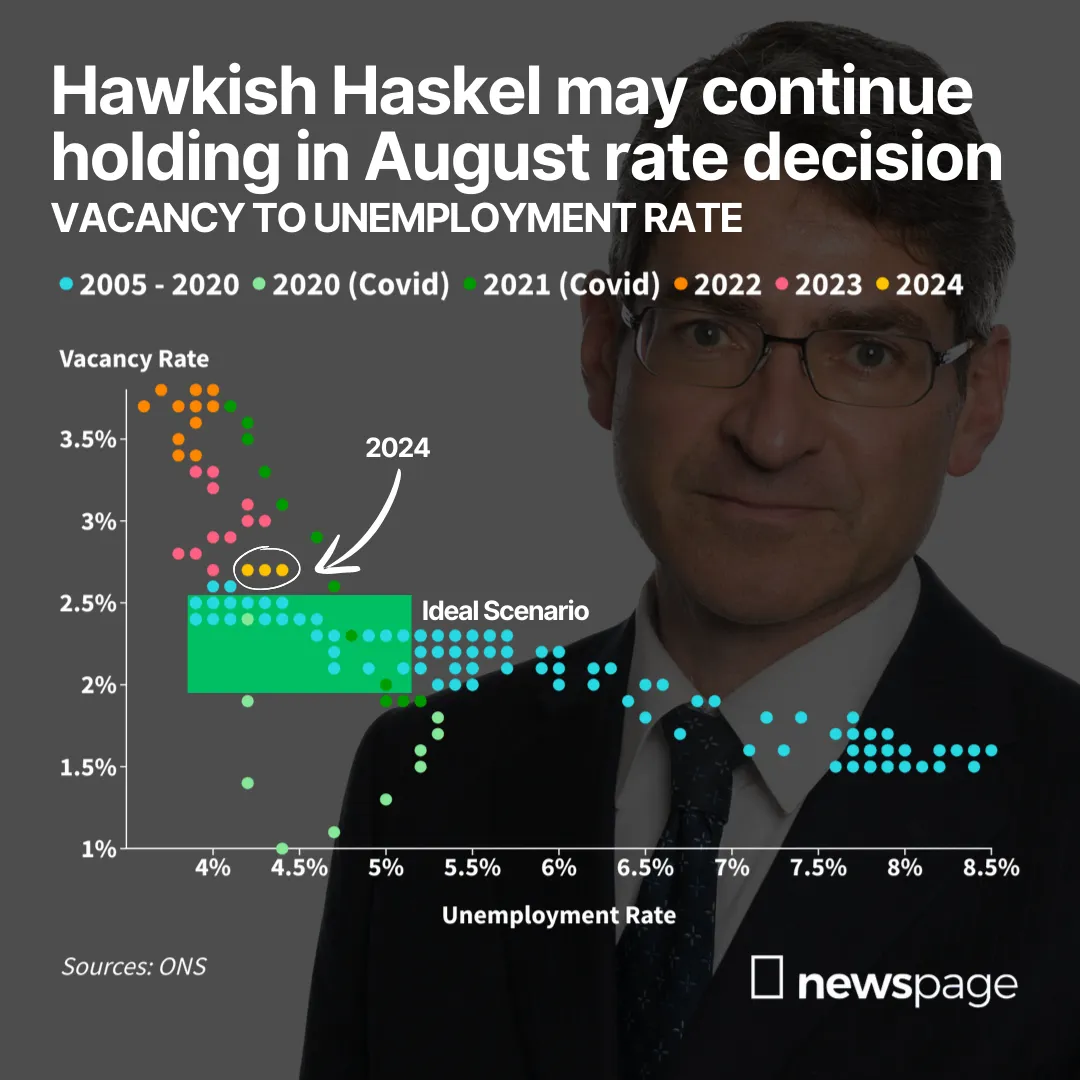
Nonetheless, it remains Haskel's go-to metric, and unfortunately, it's unlikely he'll shift his tone come next week. The top left signals a very hot market, with high vacancies and low unemployment, resulting in high inflation. On the other hand, the bottom right indicates a very weak market, with low vacancies and high unemployment, resulting in deflation.
Haskel's goal is to get this indicator back down towards the bottom left, or at the very least, closer to pre-pandemic levels (light blue dots). The green box would be the ideal scenario, where most of those dots consistent with steady 2% inflation are.
But even though good progress has been made since 2022 and 2023, the data so far shows a stagnation in 2024. This could force Haskel to retain his hawkish stance, as he fears that any surge in demand could push those dots back up and fuel the inflation fire again.
Even so, wage growth is projected to cool with services inflation expected to follow in the coming months. This should bring those yellow dots down into the green box. But Haskel isn't a big fan when it comes to forecasts, and prefers datasets provided by the Office for National Statistics (ONS). As such, it will be a huge surprise if Haskel votes for a cut next week.
Having said that, it's worth noting that this will be Haskel's last meeting on the MPC. But with no replacement lined up just yet, the MPC will go into their following meeting with one less hawk, thereby increasing the odds of a rate cut in September. So, unless another hawkish member is appointed by the Chancellor, rate cuts could look like a matter of when and not if in Q4.
Publishers: if you use any, or all, of the copy above or responses in this News Alert, please credit Newspage, e.g. "Speaking to the Newspage news agency, XXXX said...". For ease, all, or individual quotes, or all of the article, can be copied.