Copy article

5-year swaps are almost as high as a year ago

ended 12. March 2026

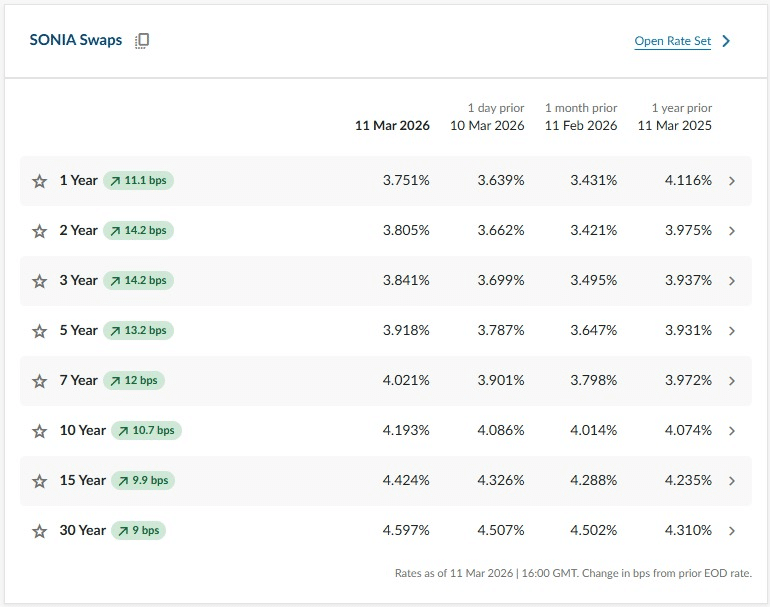
Five-year swap rates are almost at the same level as a year ago as they continue to rise amid the Iran war.

It is now 3.918%, up from 3.787% a day ago and up from 3.647% a month ago. It's now almost the same level as one year ago when it was 3.931%.

  • What does this mean for mortgages and the economy?
  • Why are they spiking?
  • Any other thoughts?

Responses asap.

7 responses from the Newspage community

Copy all

Star Quote
Copy

Rising swap rates lead to higher mortgage rates and also signal that markets expect interest rates to stay higher for longer, which can reduce affordability for borrowers and increase borrowing costs for businesses, potentially slowing housing activity and wider economic growth.

Markets are becoming less confident that interest rates will fall soon, with geopolitical tensions and inflation risks pushing expectations towards rates staying higher for longer.
Copy

We have effectively seen almost a year’s worth of rate reduction progress wiped out in the space of a week. Markets are very risk-averse. They want stability, clear direction and a better outlook. Right now they have none of that, so the cost of borrowing is rising fast and lenders are pricing in more uncertainty.

That does not just affect mortgages. It hits affordability, weakens confidence and risks slowing the housing market sharply. If this war drags on, this stops being a mortgage story and becomes a much wider economic one.

This is a moment that needs firm leadership and clear action from government, but after 18 months in power they have given little sign that they are willing or able to take charge, and that is why I fear the worst.
Copy

The good progress made over the last year has been undone by the action of one man. The domino effect in full force. If sustained, the higher rates will have an impact similar to what was seen in the UK one or two years ago, with buyers reluctant to proceed with purchases, holding off until rates simmer down, stalling the market.
Copy

Swap rates the not-so-secret driver behind fixed mortgage pricing have been jumping around like a rave party amid tensions in the middle east.
When swap rates rise, lenders’ funding costs increase and that usually means higher fixed mortgage rates. For first-time buyers, that can mean borrowing less or delaying a purchase. For homeowners coming off fixed deals, it’s another blow. Many were hoping refinancing in 2026 would be cheaper than the past two years. This spike is pushing rates higher again. And with the Oil prices skyrocketing it is inevitable that we will have Rising energy prices and inflation which may force the Bank of England to keep the base rate static for longer. A reminder that global events can quickly hit home and is often felt through your mortgage payments.
Copy

A year's worth of rate progress wiped out in a week. That is the brutal reality of what geopolitical turmoil does to borrowing costs. Five-year swaps at 3.918% are practically back to where they sat 12 months ago, and every basis point increase feeds straight into mortgage pricing.
Oil prices, fuel costs, and the real threat of inflation are taking their toll. Markets hate uncertainty, and right now they have nothing but. If there is no path to peace soon, lenders will keep pricing in risk, confidence will weaken, and the housing market could stall sharply. This stops being a mortgage story very quickly; it becomes an economic one. The question is whether anyone in government has the nerve to act before it spirals further.
Copy

In this world we live in nothing is straightforward and nothing is predictable.

We have seen the world turn upside down by the recent events in the Middle East. These geopolitical tension have undone the good done over the last year when we saw inflation and base rates fall. Confidence was increasing and banks were happy to lend more to homebuyers.

Right now the landscape looks rather shaky. The drones have not only hit Tehran but also our economy. Swap rates have edged up to 2025 levels undoing the gradual decline in rates.

With the spectre of inflation rising again there is now a real prospect that rates will be higher for longer. First time buyers will once again be in a quandary to buy now or wait. Brokers will have to be on their toes in the coming weeks

Copy

The recent pressure on swap rates brought on by a surge in energy prices due to the tension in the Middle East has led to lenders swiftly increasing mortgage rates. It's not good for an already turgid economy and will further slow the housing market.
Will this lead to the Bank of England having to do a u-turn with the base rates and being forced to increase them instead of continuing on their easing path?
We haven't seen enough u-turns on policy recently have we?