Copy article

"Unpredictability of geopolitics and energy markets" could stoke inflation fire above 3%

Journalist: John Choong (Head of Markets and Research), Newspage

ended 26. August 2024

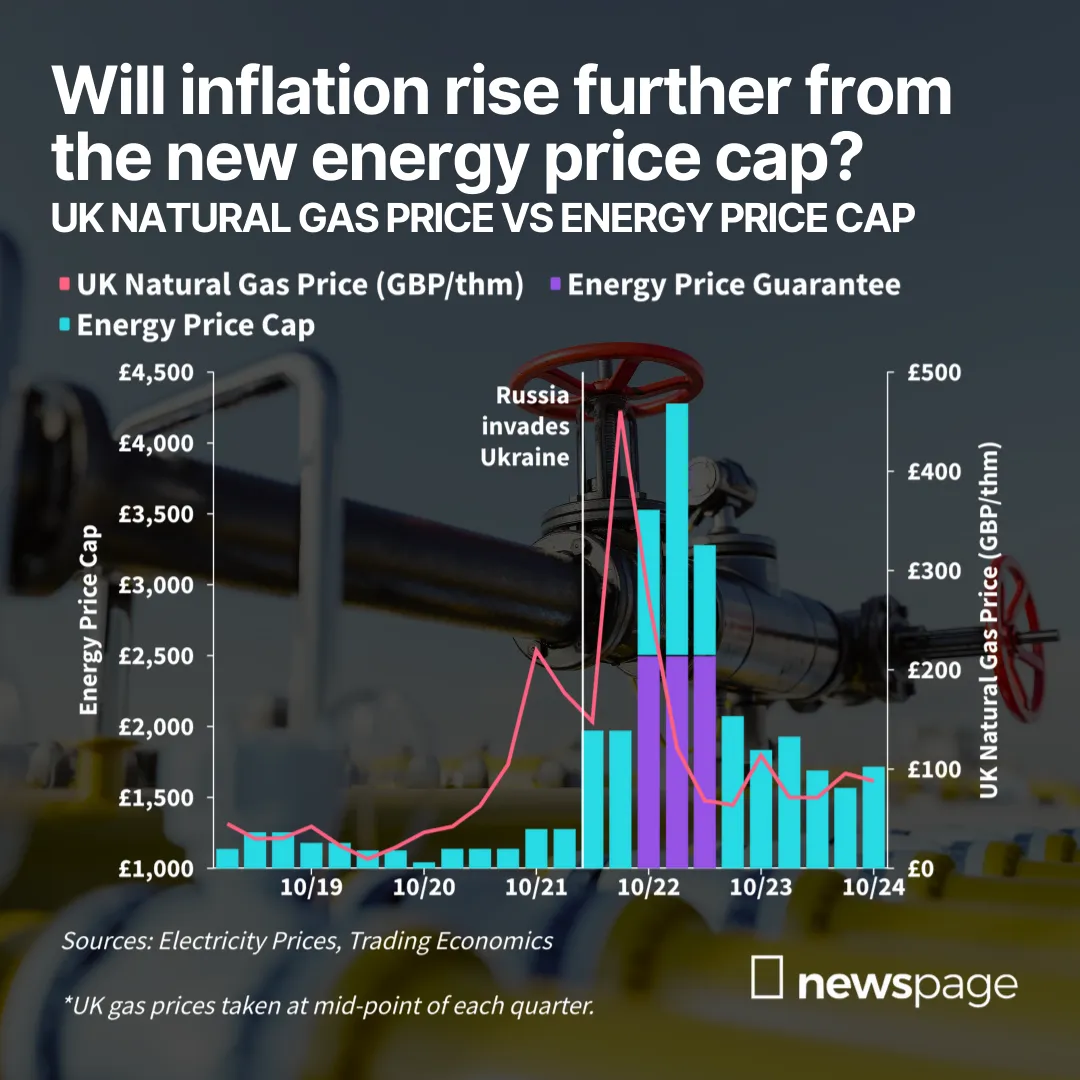
With the price of gas rising as much as 75% since February, Ofgem has increased the energy price cap in Q4 to £1,717 from £1,568. Previously, the deflationary impact of energy prices had tremendously helped to bring headline inflation down to the Bank of England’s (BoE) 2% target. But with that deflationary tailwind now beginning to subside, CPI peeked back up above the BoE’s 2% target in July.

The Bank of England (BoE) may have factored this into its forecasts, but the Bank still estimates CPI to peak at 2.7% in Q4 before returning back to its 2% target in early 2026. However, what the market doesn't seem to have accounted for is an element of uncertainty and worry, as any further uptick in gas prices from their current levels could have a detrimental effect on CPI, and force inflation to remain above the BoE’s 2% target for a longer period.

Energy has a direct impact on approximately 27% of the Consumer Price Index (CPI) basket through the “Housing and Household Services” and “Transport” categories. This makes it the biggest determinant of inflation, and that’s not including the spillover effects of higher energy prices through other categories such as food, apparel, and travel.

In October 2022, when inflation hit its peak of 11.1%, both energy-heavy categories contributed to 45% of the inflation basket. Since then, however, energy prices have subsided and have even been deflationary in certain months.

The good news is that the energy price cap tends to have a one-quarter lag behind gas prices. Thus, with gas prices cooling since hitting a recent peak earlier this month, consumers could see a lower energy price cap return in Q1 of next year. But on the other hand, with geopolitical tensions running high, this puts gas prices at a pivotal juncture, as any further increases could easily lead to higher inflation.

Newspage asked experts how inflation and, in turn, interest rates could be affected by the energy price cap — and where they expect it to peak. Their views are below.
4 responses from the Newspage community

Copy all

Star Quote
Copy

We expect the 10% rise in the Ofgem utility price cap on 1st October to push CPI inflation up from 2.2% in July to around 2.9% by November. This could delay the Bank of England's return to the coveted sub-2% target until mid-2025, turning the inflation countdown into a marathon rather than a sprint. Additionally, if recent substantial public sector pay deals influence private sector wage growth, both wages and services inflation could remain persistently high. However, there should still be sufficient breathing space for the Bank of England. Therefore, we don't think the hike in the energy price cap is likely to completely derail the rate-cutting train. It's more of a speed bump than a roadblock on the path to monetary easing.
Star Quote
Copy

In the inflation tug-of-war, future energy prices have a firm hold on the rope, with unpredictable gas prices threatening a graceful return to target inflation. The energy market is a fickle beast, and just when you think you've tamed it, it rears its head again. Any geopolitical uncertainty, particularly in the Middle East, could drive this peak further. Despite reassurance that inflation will return to target in early 2026, the spectre of rising gas prices looms large, threatening to derail forecasts. This, combined with the consistent lag in the energy price cap, means the MPC will be driving with their rearview mirror, and any sudden price increase could catch policymakers off guard. In the inflation storm, energy prices are the unpredictable winds. As a result, consumers should remain alert and ready to adjust their sails.
Copy

Gas prices and energy in general are key factors in the inflation print data that can single-handedly skew the outlook. Inflation is almost certain to creep back up over the coming months and not all because of gas prices. There have been many announced public sector wage increases which will also apply pressure to the inflation guage. However, provided it stays under 3% at its peak, the economy should be able to ride the wave.
Copy

We believe inflation will peak below the BoE's 2.7% estimate in Q4 if current geopolitical tensions don't escalate any further. We anticipate the quicker-than-expected unravelling of services inflation to help offset the increase in gas prices. However, we don't believe markets have priced in much upside risks for a potential energy crisis either. For one, Norway's planned maintenance is set to slash pipeline gas deliveries by nearly 50% in September, but that hasn't spooked markets yet. And as the UK's primary gas supplier, it's a ticking time bomb of uncertainty. Moreover, if geopolitical tensions continue to heat up, further supply disruptions could come as a result. While the downside for gas prices remains significant if supply hiccups don't materialise, the upside risks are equally formidable. The BoE estimates gas to average at £92 per therm for the rest of the year. But if gas prices continue their upward trend, the MPC's rate-cutting cycle could swiftly go into reverse.