
Can Labour realistically revive the flagging UK stock market?
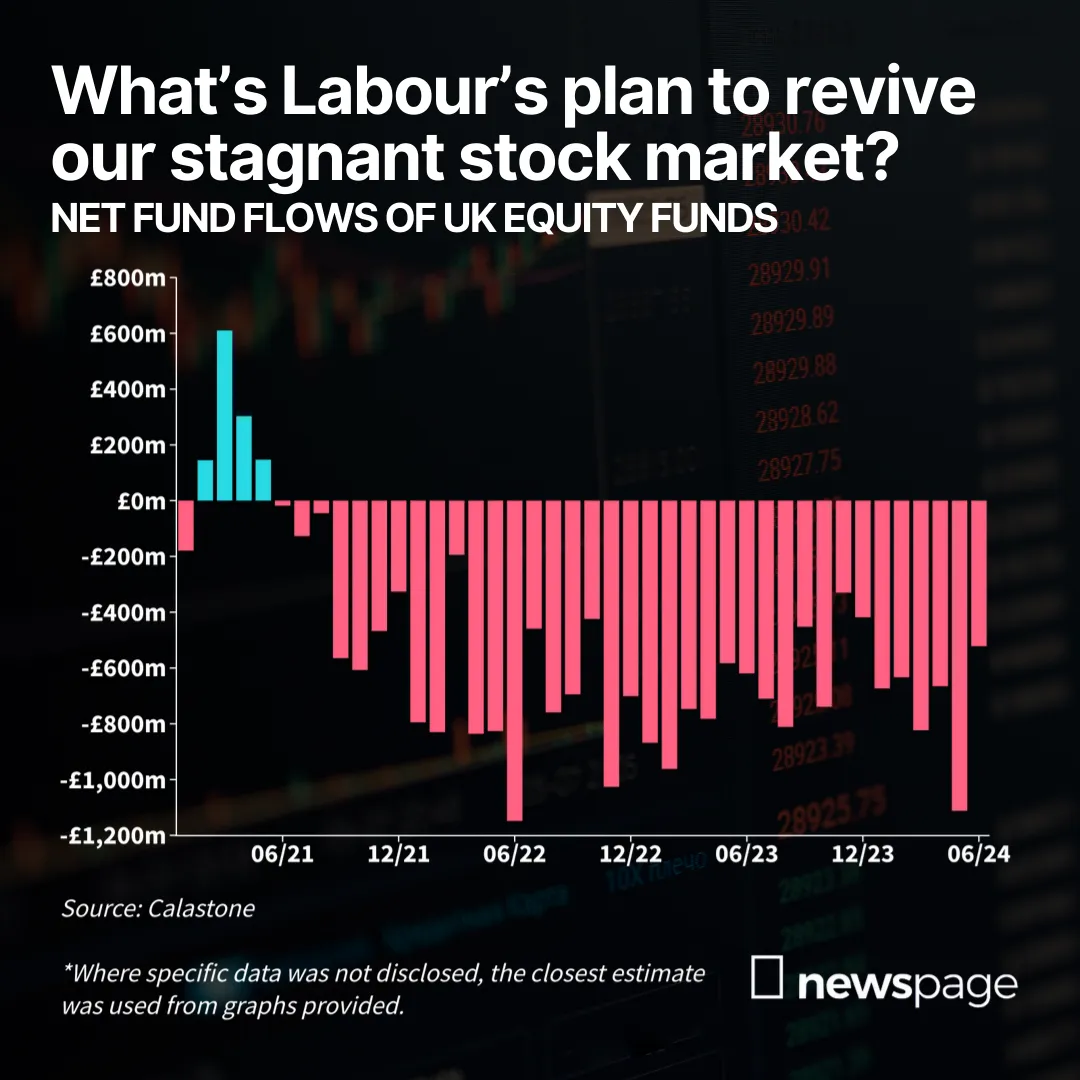
With delistings on the London Stock Exchange seemingly happening on a monthly basis and the lack of an IPO pipeline, the money is quite literally flowing out of the British stock market (see graphic above).
As such, it’s no surprise to see investors continue pulling their funds out of UK equity funds for a 37th consecutive month, according to research from Calastone. This trend was backed up last week by data from the Investment Association (IA). The IA reported sales into global equity of £434m in May, making it the top selling equity sector, while sales to UK equities worsened, as it saw a record outflow from UK equity funds of £1.8bn during the month.
Labour’s pledge to encourage pension funds to invest more in domestic businesses could be the first step in reviving what seems to be a dying market. Nonetheless, questions still remain as to how the new government plans to achieve this. A British ISA has been touted, although developments surrounding its implementation remain up in the air.
And with Reeves’ constant reiteration of wanting to gather private investment rather than dry up the nation’s reserves in order to fund Labour's ambitious plans, the lack of a proper strategy to make the UK’s stock market more attractive could hinder opportunities for public sector investment.
Wes Wilkes, CEO at wealth manager, Net-Worth NTWRK, said there is no easy fix to the problem that is the UK stock market but that Arm Holdings is a perfect example of why the FTSE 100 is out on a limb: “The UK's beleaguered stock market issues go much deeper than simply directing pension schemes through policies or individuals via a British ISA to just allocate more to UK companies. If we assume the US is investment utopia, a major reason why the UK has fallen further behind is because we don't have the technology sector of our US counterparts. Arm Holdings, a British semiconductor company, is one such example. Having previously been dual-listed on both the London and New York stock exchanges, Arm is now only listed in the US. And with the firm having a massive market cap of almost $200bn today after rising nearly 200% in the last year due to a chip-powered AI boom, it would have been one of the FTSE 100's biggest constituents today. This would have powered the FTSE to greater heights and done the UK stock market a world of good. Retaining British ownership of firms such as ARM is crucial if we are to see a stronger UK stock market that can compete with our friends across the pond.”
Riz Malik, Independent Financial Adviser at R3 Wealth echoed the sentiment and offered a suggestion: “The government needs to bring sexy back to listing on the London Stock Exchange and investing in UK Plc as a whole. We need a charm offensive and to create an environment and ecosystem where businesses can grow and thrive. We need to tell the world that, as of 5 July, the UK is open for business. There are two such ways to achieve this. One is for the government to take a look at the possibility of reforming the way shares are listed and traded in this country. The much stricter requirements when it comes to listing a company publicly are a turn-off for firms that can go directly to the NYSE or NASDAQ to list instead. Secondly, there's not much to keep them here either, as trading volumes are nowhere near as high as the US, thereby making it more difficult for companies to raise capital. As a result, the government should consider reforming the 0.5% stamp duty they currently charge for buying UK shares if they really want to breathe life back into the equity market.”
Joshua Gerstler, Chartered Financial Planner at The Orchard Practice, concluded: “Yes, we want the UK to be an attractive destination for businesses to list. However, from a personal finance point of view, most investors have moved away from a predominantly UK investment portfolio into a global equity portfolio. Therefore, we want the UK to continue to grow as well as the global economy. But if we want to encourage more British investors to invest in their local stock market, more needs to be done to incentivise this."


