
Copy article

US ADP report sees private payrolls rebound, and will "likely open a Pandora’s Box" for Fed

Journalist: John Choong (Head of Markets and Research), Newspage

ended 02. October 2024

In the lead up to Friday's all-important non-farm payrolls numbers, the latest jobs report from Automatic Data Processing (ADP) shows that the labour market may not be as weak as markets have been making it out to be.

According to ADP, private businesses managed to add a net of 143k workers to their payrolls in September. The headline print also beat consensus estimates of 120k, rebounding off its 3-year low. This comes on the back of an upwardly revised figure for August as well, with jobs created at 103k, as compared to the initial 99k reported last month.

ADP Chief Economist Nela Richardson said: “Stronger hiring didn't require stronger pay growth last month. Typically, workers who change jobs see faster pay growth. But that premium over job-stayers shrank to 1.9 percent, matching a low we last saw in January."
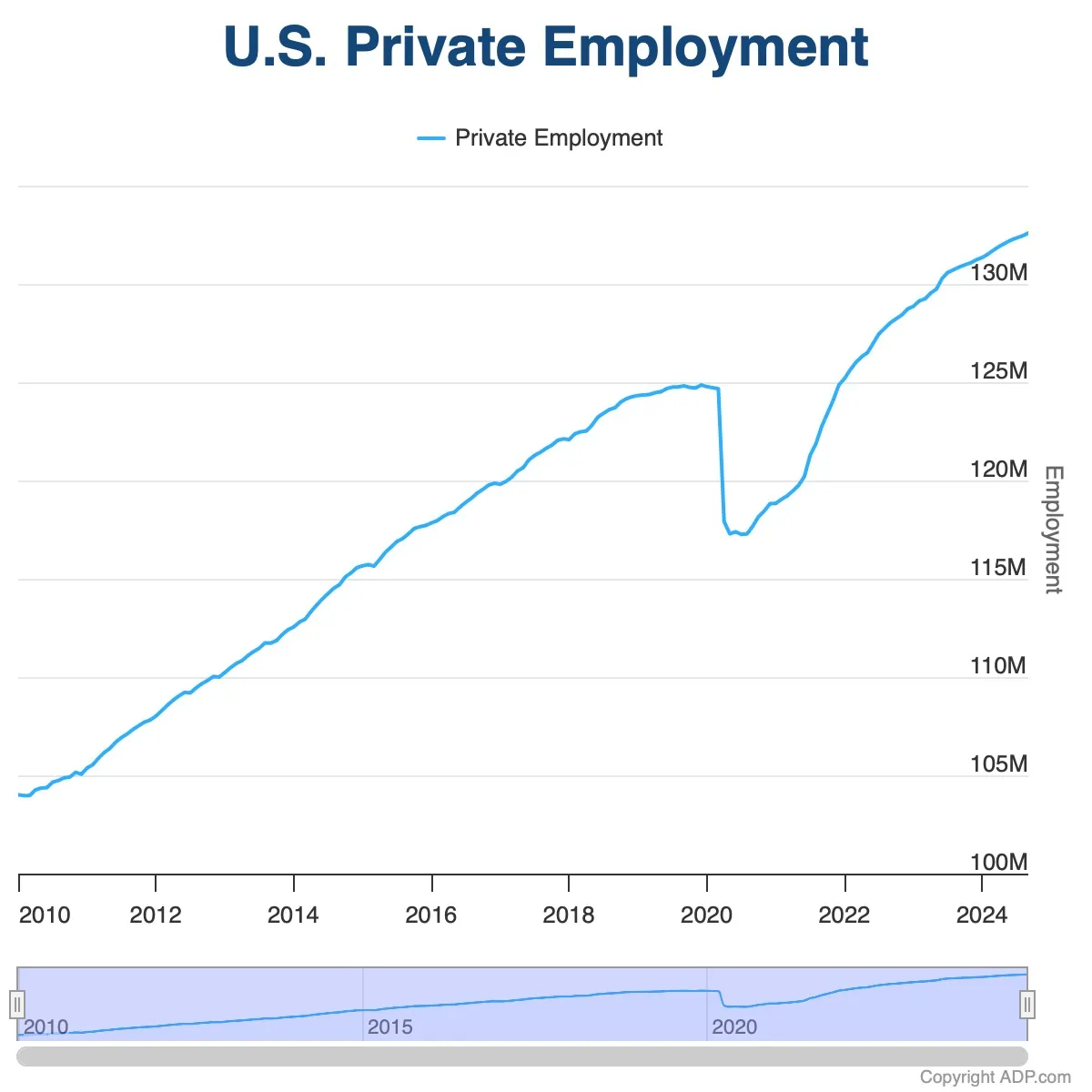
Newspage asked economists, analysts, and traders on what this could spell for the non-farm payrolls numbers on Friday, what this suggests about the US labour market, and the outlook for rate cuts.

3 responses from the Newspage community

Copy all

Copy

Wall Street's crystal ball cracks as job numbers shatter expectations once again, with the US labour market thumbing its nose at pessimistic forecasts. September's figures represent a marked increase from August's 99,000 job additions, painting a picture of a labour market that seems to have found its second wind just as many expected it to wheeze to a halt. This stronger-than-anticipated job growth will likely open a Pandora’s Box of policy decisions for the Federal Reserve. On the one hand, it suggests continued economic strength, which might typically call for tighter monetary policy to prevent overheating. However, the deceleration in wage growth could indicate that inflationary pressures are naturally easing, allowing the dovish tilt to continue. Additionally, market expectations of a 50bps November rate cut have dwindled to 35% from nearly 60% a week ago. As attention turns to Friday's official non-farm payrolls report, investors are likely bracing for more potential surprises.
Copy

The latest ADP report is particularly encouraging given the recent trend of government-led job creation propping up the NFP numbers. However, ADP's data should still be held with caution, as the disconnect between ADP and NFP reports over the past year suggests we shouldn't draw hasty conclusions just yet. ADP's reported expansion in manufacturing employment since April, is just one example of this, as it contrasts sharply with the ISM manufacturing PMI's employment data, which saw the second-biggest contraction in 4 years.

The most promising aspect of this report, however, is the continued cooling of wage growth. Job stayers saw wage growth decrease to 4.7% from 4.8%, while job changers experienced a more significant drop to 6.6% from 7.3%. This trend, coupled with yesterday's JOLTs report showing a 4-year low in the job quits rate at 1.9%, bodes well for inflation, particularly for supercore inflation, which is highly wage-sensitive.
Copy

The issue with the ADP payrolls number is there’s very little correlation with the following Friday’s NFP print when taken as a whole. Right now, however, we know the US employment situation is worsening a little, which makes the ADP numbers more correlated with NFP, as the government payrolls are factored out more.

In short, when economic times are bad, NFP looks better than ADP and the correlations break down.

As a trader, and a proponent of being long the S&P 500 in perpetuity, I am hoping for a number inline on Friday so expectations on rate cuts are not altered too much. We want low volatility to make buying far easier.