
Copy article

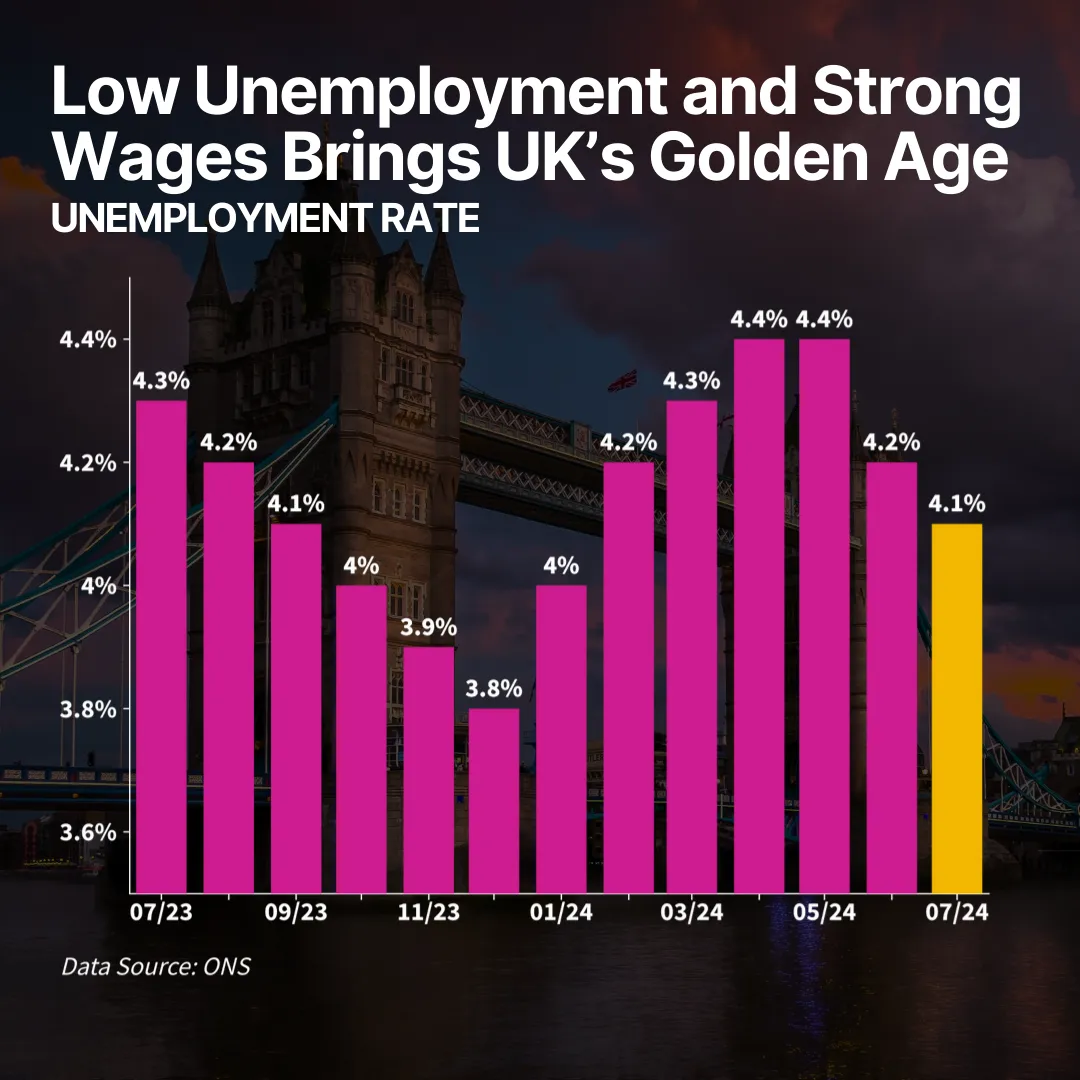
Low unemployment and strong wages brings UK's golden age

Journalist: John Choong (Head of Markets and Research), Newspage

ended 10. September 2024

The UK may be ushering in a golden era after the latest labour market data showed another set of “Goldilocks” figures. The unemployment rate in July dropped to 4.1% from 4.2% – the lowest since January, while pay growth continued to cool. Meanwhile, total pay growth dropped to 4.0% from 4.5%, while regular pay growth slid to 5.1% from 5.4%. With headline inflation currently at 2.2%, real wage growth continues to trend positive at 1.8%.

Considering how crucial what the Bank of England (BoE) classifies as “full employment” is to the UK’s strong economic growth thus far in 2024, a low 4% unemployment rate positions Britain’s economy to continue powering on. Given that real wages also remain firmly positive despite wage growth cooling, this gives workers more discretionary income to spend, thereby giving the economy a further boost.

Be that as it may, today’s data could also eradicate the possibility of what was already a slim chance of a September rate cut. Still, markets continue to expect another 25bps cut before the end of the year, which should further serve as a catalyst in a healthy economy held strongly together by a resilient labour market.

Newspage asked economists, IFAs, and analysts for their views on what the latest data could imply for the UK economy, a September rate cut, and other securities such as commodities.
4 responses from the Newspage community

Copy all

Star Quote
Copy

The labour market is dancing to its own tune as the latest figures show remarkable resilience despite a rising number of claimant counts over the past couple of months. With wage growth still at an elevated level as well, the MPC is now more likely to maintain a hold at its September meeting.

That said, this could bode well for Britons as Sterling is likely to continue its momentum against major currencies, reflecting increased expectations for monetary tightening to last longer, thereby making imported goods and travel to overseas cheaper.

However, prolonged tightening could pose challenges for more interest rate-sensitive sectors, especially small caps, which could suffer due to higher borrowing costs.

But with healthy real wage growth, relatively low unemployment, and steady inflation, we could be entering a Goldilocks scenario for the UK economy, especially after a strong first half of growth in 2024. Although, questions remain as to how long this fairy tale can last.
Copy

These figures are a double-edged sword. Excellent signs for the wider UK economy, but may make the Bank of England hold out for longer before applying a second base rate reduction in September.

Lenders still remain confident though with another rate cut priced in before the year end, and every week is seeing more lenders reduce their rates for borrowers, so perhaps the feel-good factor is the largest winner here.
Copy

As the old adage goes, "Where there's cash, there's splash." With full employment, fatter wallets, and shrinking price tags, British consumers are poised to party like it's 1999 as the cost-of-living crisis continues to turn a corner. Consumer confidence is surging, businesses are whistling optimistically, and the economic outlook for Britain is the brightest it has been in a long time.

The stars seem aligned for the UK to be on the cusp of a golden era, but there's a potential fly in the ointment – the government's itchy tax-hiking finger, as one wrong move could turn the current economic symphony into a discordant mess.

Meanwhile, any whispers of a September rate cut have been silenced by the labour market's muscular performance. With economic indicators flashing green, the MPC should see no reason to rush for the scissors later this month.
Copy

The latest "Goldilocks" data might offer a rosy snapshot, but for many citizens, the news will offer cold comfort. While unemployment dips and real wage growth edges up, "rate shock" isn’t going away for homeowners and investors moving from historically low mortgage rates to today’s new norm.

Lenders may have eased rates slightly, but millions of people are still juggling with stretched budgets, with rising living costs adding to the strain. A September rate cut is unlikely, and even another 25bps won’t ease the pressure. The economy may look resilient, but the social impact of these shifts is largely ignored. Great news for UK PLC no doubt, but real relief, not cosmetic tweaks, is what’s needed.