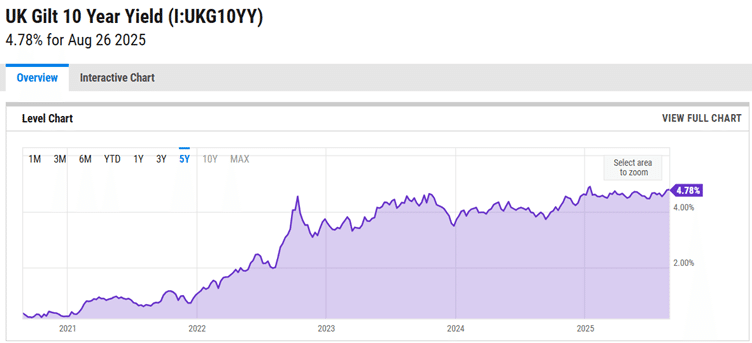
"UK's credit card is maxed out": Experts warn that Rachel Reeves is caught in a debt trap of rising gilt yields
EXPERTS are warning that Chancellor Rachel Reeves is caught in a debt trap of rising gilt yields and have likened it to "UK's credit card being maxed out".
Rising gilt yields are tightening the rope around the Treasury’s neck, leaving Labour's Reeves little room to manoeuvre ahead of her Autumn Statement.
Economists now warn of parallels with the sterling crisis of 1976, when Britain was forced to turn to the International Monetary Fund (IMF) for help.
But with debt levels spiralling across the G7, and questions over the IMF’s capacity to rescue a country like Britain in 2025, many fear the trap is already set.
Anita Wright, Chartered Financial Planner at Ribble Wealth Management commented: "Ballooning deficits, foreign reluctance to hold gilts, and policy missteps erode confidence.
"Debt interest is already consuming an ever-greater share of the budget, while Reeves finds herself politically boxed in – unable to raise taxes without driving away high earners and businesses, and unable to cut spending without fracturing her parliamentary base.
"These are precisely the conditions that once forced the UK into the IMF’s arms. That of course does not make an IMF bailout inevitable, but it does mean that the UK faces a crisis dynamic that could spiral faster and more violently than in the seventies. If sentiment cracks, the impact will be felt almost immediately.
“A sharp fall in sterling would drive up the cost of imported goods, worsening inflation just as households are already squeezed. Higher gilt yields translate directly into steeper borrowing costs for government, banks and businesses, meaning mortgages and corporate loans would become prohibitively expensive.”
Daniel Wiltshire, Actuary & IFA at Bradford-on-Avon-based Wiltshire Wealth, said Reeves has “boxed herself in” politically.
He said: "This is bad politics. By ruling out tax rises on “working people,” Reeves has boxed herself in. The easiest way to raise revenue – higher income tax or national insurance – is off the table.
"With limited options and debt costs soaring, a weak Budget could trigger a fiscal doom loop: markets demanding ever higher interest, driving even greater pressure for tax hikes."
Rob Mansfield, Independent Financial Advisor at Rootes Wealth Management warned that the UK's "credit card is maxed out".
He said: “This is the next budget black hole forming. The governments approach is to go for growth and try and grow the economy so the debt shrinks in comparison.
"With debt to GDP rapidly approaching 100%, this is a high risk strategy and combined with tax rises on business, it looks even riskier.
"An alternative would be to focus on efficiency and effectiveness to do more for less but it seems that it doesn't matter what party is in charge, the only approach is spending more money. The credit card is maxed out.”
Tony Redondo, Founder at Newquay-based Cosmos Currency Exchange, dubbed the debt a “moron” tax on the UK.
He said: "The bond markets have already forced the UK to pay a ‘moron’ tax on its ever-rising debt mountain. The UK is already paying more in interest payments to service its debt than on defence or education. The situation is serious.
"The 10-year gilt yield rose to 4.8%, the highest since 2008, while 30-year gilts climbed to 5.22% on Tuesday, surpassing last year's peak as borrowing costs surged to their highest level since 1998. The Office for Budget Responsibility (OBR) highlights just how vulnerable the UK position is.
“With net debt around 100% of Gross Domestic Product (GDP), a 1% increase in gilt yields increases debt interest spending by around 1% of GDP (£30 billion in 2024-25 terms) in the long run. With her own party refusing to allow Reeves to cut spending, the only option is yet more tax increases, which will bury the economy. A run on the Pound is almost inevitable. At least we will not be alone as the French will be keeping us company.”
Samuel Mather-Holgate, Independent Financial Adviser at Swindon-based Mather and Murray Financial, warned of a crisis.
He said: "Make no doubt about it, Britian is in crisis. The markets see what’s happening and they have given their verdict through rising bond yields. Reeves needs to raise money and stimulate growth and she’s doing neither.
“Bound by the ridiculous commitments in Labour's manifesto, they are left to tinker around the edges whilst Rome burns. One of these protected taxes needs to be raised, and growth strangling taxes like business national insurance need to be scrapped. This way she might get the shot in the arm the economy needs and raise receipts at the same time.”
Keith Budden, Managing Director at Liss-based Ensurety said there is a tough year ahead.
He added: “I can't see Rachel from accounts making any significant move ahead of the budget, but come the budget itself I think it's time to stop talking about tax rises or spending cuts, but replace that or with an and. There is no doubt we are in a dire financial situation as a country.
"We are technically avoiding a recession but to the average person or business it doesn't feel like that. Yes tax rises and spending cuts will be painful but I really think Reeves has no choice.
“We have a hard 12 months to come, what Reeves does need to do is show us what the sunny uplands beyond look like so we are all ready for the journey with a heavy rucksack on our backs – can she do that? The jury is out.”