
Copy article

Amid trade war, is it time to resurrect "home bias" and back UK equities again?

ended 12. March 2025

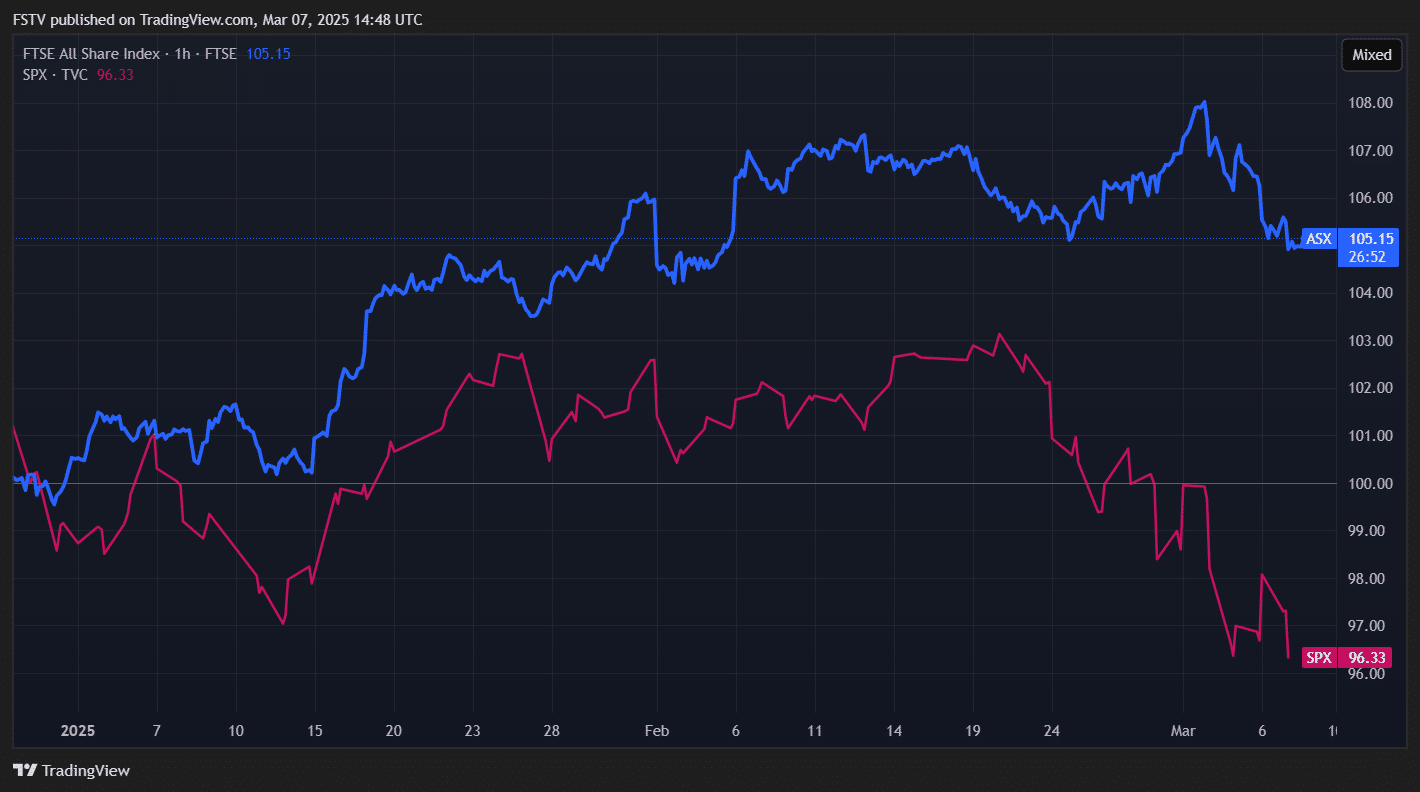
Amid the escalation of the trade war, some market commentators feel we could be nearing the end of a 15-year period of US dominance, which has led to America making up around 75% of all global equity market capitalisation — and that the UK could benefit. Since Christmas, the UK’s FTSE All Share index has outperformed the US S&P 500 stock index by about 10%. Over the past 30 years, the typical UK investor has likely seen their UK exposure fall from circa 25% to somewhere more like 5% (closer to the UK’s global market weight, which is about 3.5%). That’s been a rational and profitable move as other markets — especially the US — have fared better than ours. But with the UK equity market much cheaper than its US counterpart and paying 3.4% in dividends each year, Newspage asked experts whether now is a good time to reconsider “home bias” and back the UK equity market again. Some believe it is, others said it categorically is not.
5 responses from the Newspage community

Copy all

Star Quote
Copy

Many UK investors have significantly reduced their domestic equity exposure over the past three decades, whereas valuations in the US have remained historically elevated. However, this recent performance shift has raised questions about whether the UK now presents a more compelling risk-reward balance for long-term investors. Although the FTSE lacks the high-growth technology giants that have propelled US equities in recent years, this could actually serve as an advantage in an environment where value and stability are increasingly in demand. Our in-house research found that the sentiment amongst professional investors and institutions is currently neutral towards the UK, in line with the wider European markets, however within our global Sad Rabbit model portfolio, we currently hold a 13.5% UK equity allocation, which has increased from last year, reflecting the significant discount of FTSE companies, offering a compelling entry point for investors seeking undervalued opportunities.
Star Quote
Copy

Back in the 1980s and 1990s, most portfolios held excessive exposure to UK equities. It was right to unwind that in favour of global portfolios. After all, why shouldn't you benefit from great businesses around the world? That logic still stands. Right now, we think the US is historically overvalued and many other markets are fairly valued, maybe even cheap, including the UK. Most ordinary investors will find that the percentage of their portfolios in US equities has crept up over the past decade as American tech stocks have roared ahead. The next ten years might be very different, however. It could be a smart move to take some of those gains and put them towards what is still an unloved and therefore cheap market closer to home. It may be time to resurrect home bias and back UK equities again.
Copy

The notion of "home bias" in the UK market is somewhat misleading, given that the majority of FTSE 100 companies generate a significant portion of their profits overseas. Despite the UK market underperforming the US over recent decades, investors in UK equities—such as those tracking the FTSE 100—have still seen returns of around 8% per year over the last decade. While the UK market may not be definitively undervalued, the extreme expansion of the US market—driven by unprecedented monetary stimulus—has distorted global valuations. Therefore, rather than assessing UK equities in isolation, investors should consider broader macroeconomic trends and the sustainability of returns in different markets. If the American market were to collapse, it would likely decline more sharply than European or UK markets. In that context, UK equities could serve as a relative hedge. The US market, being the most overinflated, is likely to see the steepest correction.
Copy

Absolutely not. The UK market is not aligned with global trends. We have fewer tech firms listed on the FTSE now than we did 30 years ago, for example — and the most recent mega firms firms, Darktrace and ARM, got taken away from the UK market. Incentives are not aligned for a good business environment here and it will only get worse given the impact of fiscal policy on businesses that we are waiting for.
Copy

Whilst it might give rise to a sense of national pride to invest in UK PLC, now is hardly the time given the Chancellor's anti-business plans for April. With lifts to Employer NICs and the minimum wage just around the corner, British businesses will be fighting over increasingly thin margins and a new wave of cost pressures. Add to this higher CGT and an increase in stamp duty, and the country is hardly putting its hand up as an attractive investment destination. Britain is facing an anti-investor backlash because of the Autumn Budget.