
Politics

Copy article

How Britain never recovered from the 2008 financial crisis

Journalist: Oliver Price, MailOnline

ended 13. November 2024

I want to speak to an economics expert to discuss the ways in which Britain (and Britons) never recovered from the 2008 Financial Crisis.

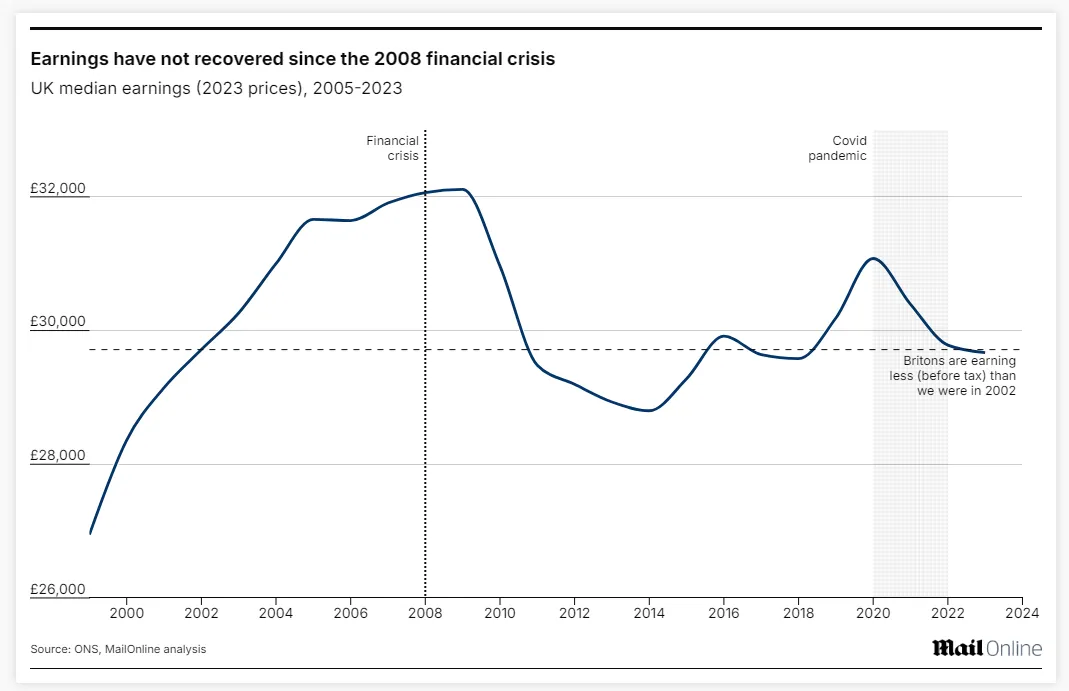
After looking at ONS data, earnings are still below what they were at their 2009 peak, by about £2500, if you put the figures in 2023 prices when accounting for inflation.

3 responses from the Newspage community

Copy all

Copy

In many respects, Britain’s recovery from the 2008 financial crisis has been partial, uneven and incomplete. Real wages remain below pre-crisis levels by nearly £2,500 adjusted for inflation with sluggish productivity growth in the private sector and none in the public. Despite the highest tax burden since 1948, public services remain under strain. Housing costs have skyrocketed, locking many out of homeownership. While the UK economy has grown since the crisis, much of that growth has been uneven, with many individuals and regions left behind. The challenges Britain faces are both economic and social, and they point to a deeper, more fundamental need for structural reforms to address inequality, regional disparities, and the long-term productivity challenges that the UK faces in the post-crisis era.
Copy

Britain is enduring its longest wage squeeze since Napoleonic times, with the shadow of austerity shaping a decade of economic struggle. Despite GDP showing growth and the stock market soaring to new all-time highs, real wages have failed to keep pace with the cost of living. This has led to Britain experiencing a 'stealth recession' where the average worker feels increasingly restricted despite wider economic growth. The true extent of this unprecedented pay squeeze is captured by the TUC, highlighting that this is the longest period of wage stagnation in more than 200 years. At the heart of Britain's economic woes lies a productivity decline, with annual productivity growth falling to just a 10th of its levels before the financial crisis. This has been exacerbated by an investment drought, with the UK lagging behind its peers. Consequently, a combination of stagnant productivity, Brexit uncertainties and global shocks has created a perfect storm that continues to batter Britain.
Copy

There is an issue that many do not see here with regards to the GFC and Europe. While the US has boomed, we have faced numerous constraints, and there is one that might be more important than people think. MiFID came around in 2009, and while the US didn’t adopt it, the UK and Europe did. This meant there were various regulations imposed on how capital transacts in our economy. While the US did not experience such stringent regulation, the UK and European firms did. These regs have, for instance, prevented UK clients from investing in the most liquid US ETFs, meaning capital has not been able to be drawn out of the US. The equivalent of SPY in the UK is VUSA… SPY has 650bn whilst VUSA has 35bn. Stupid regulation like this while seemingly trivial really isn’t, and this constrains capital markets and therefore growth.