Copy article

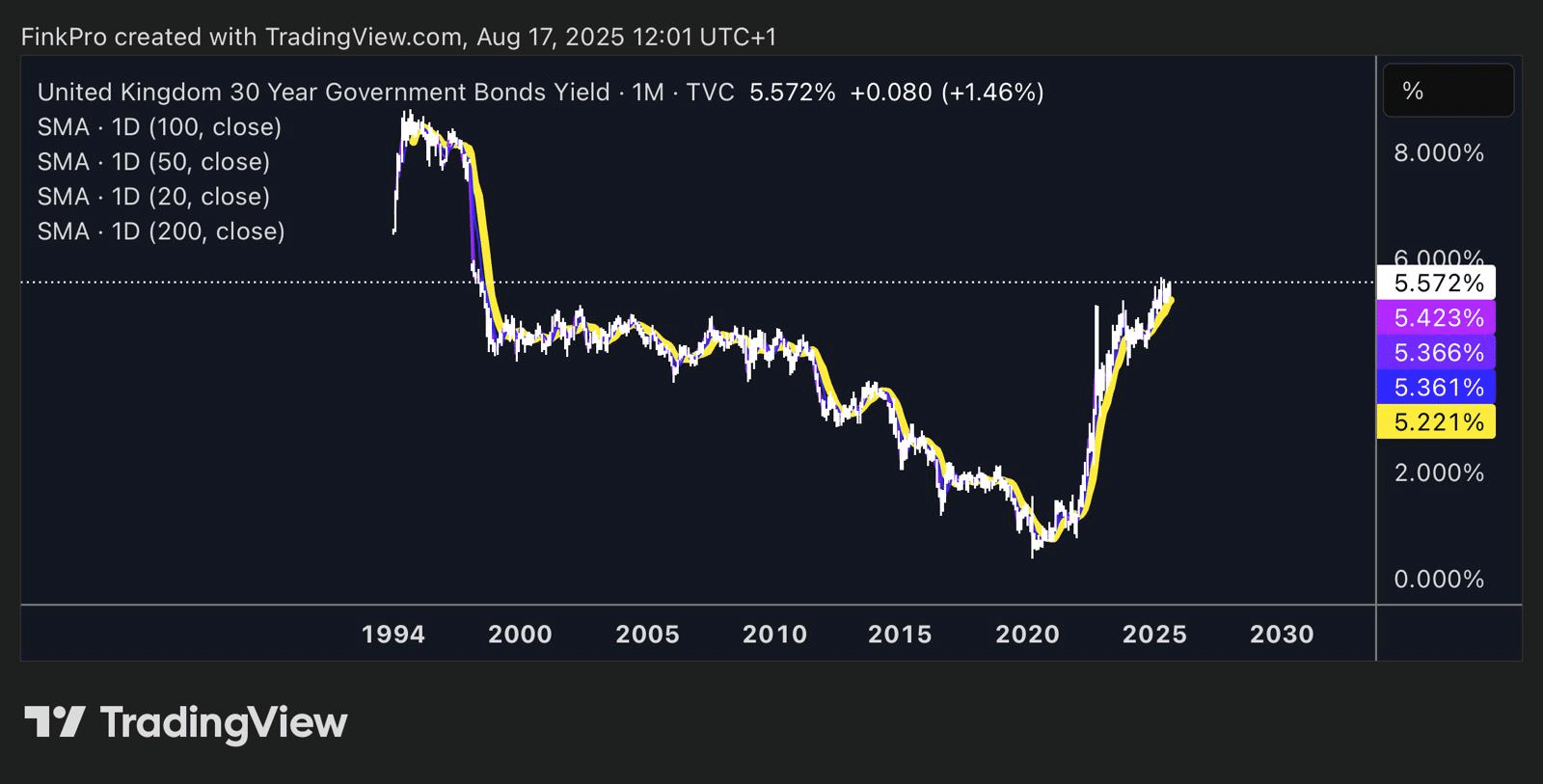
"The bond market smells blood" as 30-year gilt yield edges close to 1997 high

ended 17. August 2025

THE 30-year gilt yield edged close to its highest point since 1997 on Friday afternoon and financial experts have said the reason this is happening is because the “bond market smells blood”. A dire fiscal situation, mismanagement of the economy by Labour and the UK being “a special basket case” due to its soaring debt interest costs are key drivers.

David Belle, Founder and Trader at Fink Money, said: "The spike in the 30-year gilt yield is troubling. Deeply troubling. Despite the Bank of England's rate cut earlier this month, the 30-year yield hit 5.57% on Friday. At that level, it is just 13 basis points away from the highest point since 1997. But things get worse, as in 1997 the yield was falling and not rising.

"So why is this happening? At a basic level, the bond market smells blood. It sees the UK's fiscal situation as dire and is conscious that inflation risks are still around. The bond market perceives the UK as a special basket case due to its debt interest spending being the third biggest government spending segment. For most other nations, it is nowhere near this.

“For context, the US 30-year yield is about 50bps lower than the UK's, which is why Sterling is so strong right now. Sterling's strength is not a representation of the UK's strength, but rather of carry traders earning interest on the yield differential. The UK is running on fiscal fumes, and the markets know it.”

Anita Wright, Chartered Financial Planner at Ribble Wealth Management, said the markets see Labour's borrowing as unsustainable: "This tells us something very simple: markets don’t believe the UK has its long-term finances under control. Despite four rate cuts in the past year, the 30-year yield hasn’t come down. Why? Because investors are worried about two things: inflation sticking around and the government’s addiction to borrowing.

"In June alone, the government borrowed £20.7 billion. Shockingly, £16.1 billion of that was just to pay interest on existing debt. In other words, we are borrowing new money simply to pay the interest on the money we already owe. Everyone knows that’s unsustainable.

“The markets see this and they are demanding a higher return — pushing gilt yields up. The government needs to show real fiscal discipline, not just warm words. Investors want proof that Britain can live within its means occasionally, rather than running deficits year after year. Inflation has to be brought under control and kept there, because so much of our debt is linked to RPI, not CPI.”

Tony Redondo, Founder at Newquay-based Cosmos Currency Exchange, said Labour is in an impossible situation and the private sector could once again bear the brunt of tax rises: "History looks set to repeat itself with a re-run of the Truss debt crisis of October 2022. Bond markets are already signalling their unease with the UK’s fiscal position after Labour’s spending surge, demanding a premium even on 30-year debt amid persistent inflation. Reeves began widening the hole in the public finances on taking office and has continued digging ever since.

"To reassure markets, the government would need to reverse course, slim down the bloated public sector and cut spending. But for a Labour administration tied to the unions, that would be political suicide. Instead, Reeves is likely to squeeze the private sector further with fresh tax rises this autumn, hoping growth and cooling inflation will do the rest.

“One year into Starmer’s premiership, gilt yields stand higher than when he began, a clear sign of market scepticism. The lights are still on at Labour HQ, but nobody is home.”

Samuel Mather-Holgate, Independent Financial Adviser at Swindon-based Mather and Murray Financial, said Labour are all out of options: “If we needed proof Labour's plan for the economy isn’t working, this is it. The highest long term borrowing rates for 25 years says it all. This is not the way to run the economy. The only way to fix this is by breaking a manifesto commitment, but that will be toxic politically. Labour are all out of options and the bond vigilantes can scent it."

Rob Mansfield, Independent Financial Advisor at Rootes Wealth Management commented: “The government has to borrow as it chooses to spend more than it raises in taxes. Markets don't have to lend and rising gilt yields show that their confidence in the government's plans is reducing. This pushes the cost of borrowing up, which could lead to higher taxes, lower growth and a downward spiral.

"There's very little margin for error and the government has to act wisely. So far they're repeating last year's mistake of allowing excessive speculation and rumours leading up to a Budget, which is sapping confidence.”
6 responses from the Newspage community

Copy all

Star Quote
Copy

If we needed proof Labour's plan for the economy isn’t working, this is it. The highest long term borrowing rates for 25 years says it all. Boxing themselves in on VAT, income tax and national insurance means Labour are scrambling about on the taxes that generate less income, and hiking these to record levels. This is not the way to run the economy. The only way to fix this is by breaking a manifesto commitment, but that will be toxic politically. Labour are all out of options and the bond vigilantes can scent it.
Star Quote
Copy

The spike in the 30-year gilt yield is troubling. Deeply troubling. Despite the Bank of England's rate cut earlier this month, the 30-year yield hit 5.57% on Friday. At that level, it is just 13 basis points away from the highest point since 1997. But things get worse, as in 1997 the yield was falling and not rising. So why is this happening? At a basic level, the bond market smells blood. It sees the UK's fiscal situation as dire and is conscious that inflation risks are still around. The bond market perceives the UK as a special basket case due to its debt interest spending being the third biggest government spending segment. For most other nations, it is nowhere near this. For context, the US 30-year yield is about 50bps lower than the UK's, which is why Sterling is so strong right now. Sterling's strength is not a representation of the UK's strength, but rather of carry traders earning interest on the yield differential. The UK is running on fiscal fumes, and the markets know it.
Copy

History looks set to repeat itself with a re-run of the Truss debt crisis of October 2022. Bond markets are already signalling their unease with the UK’s fiscal position after Labour’s spending surge, demanding a premium even on 30-year debt amid persistent inflation. Reeves began widening the hole in the public finances on taking office and has continued digging ever since. To reassure markets, the government would need to reverse course, slim down the bloated public sector and cut spending. But for a Labour administration tied to the unions, that would be political suicide. Instead, Reeves is likely to squeeze the private sector further with fresh tax rises this autumn, hoping growth and cooling inflation will do the rest. One year into Starmer’s premiership, gilt yields stand higher than when he began, a clear sign of market scepticism. The lights are still on at Labour HQ, but nobody is home.
Copy

The government has to borrow as it chooses to spend more than it raises in taxes. Markets don't have to lend and rising gilt yields show that their confidence in the government's plans is reducing. This pushes the cost of borrowing up, which could lead to higher taxes, lower growth and a downward spiral. There's very little margin for error and the government has to act wisely. So far they're repeating last year's mistake of allowing excessive speculation and rumours leading up to a budget, which is sapping confidence.
Copy

This tells us something very simple: markets don’t believe the UK has its long-term finances under control. Despite four rate cuts in the past year, the 30-year yield hasn’t come down. Why? Because investors are worried about two things: inflation sticking around and the government’s addiction to borrowing. In June alone, the government borrowed £20.7 billion. Shockingly, £16.1 billion of that was just to pay interest on existing debt. In other words, we are borrowing new money simply to pay the interest on the money we already owe. Everyone knows that’s unsustainable. The markets see this and they are demanding a higher return — pushing gilt yields up. The government needs to show real fiscal discipline, not just warm words. Investors want proof that Britain can live within its means occasionally, rather than running deficits year after year. Inflation has to be brought under control and kept there, because so much of our debt is linked to RPI, not CPI.
Copy

The 30Y gilt is at levels not seen since Tony Blair was measuring the Downing Street curtains, which tells you everything you need to know about the market confidence in Rachel Reeves' fiscal credibility. To be perfectly honest, bond investors are pricing in a simple reality that this government is drunk on power, and seems busy spending other peoples' money.

I will give you my perspective as a landlord about borrowing. If your income looks shaky and your spending is reckless, lenders will always charge you more.

Reversing this mess requires something Labour seems allergic to. Actual fiscal discipline, you see. Markets need proof that spending promises come with credible funding plans, not just tax raids on employers and pension pots. Until Reeves demonstrates she understands the difference between investment and consumption, gilt buyers will keep demanding higher returns for the privilege of lending to a government that treats the national credit card like a loyalty scheme.